Home Feng Shui
Feng Shui Date Selection: Pick Your Auspicious Day
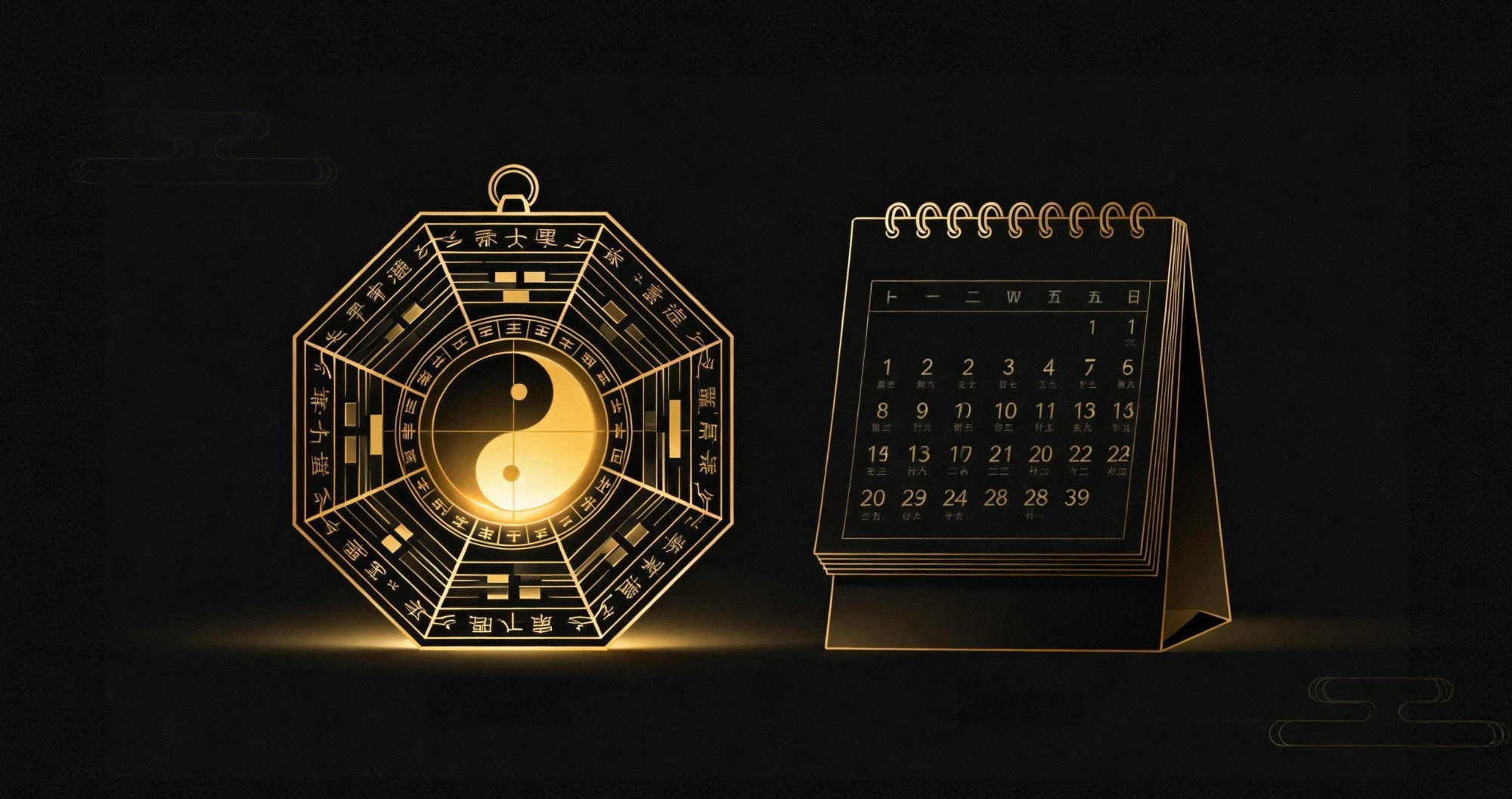
Chinese auspicious date selection (Ze Ri) is not about finding a 'lucky day.' It's a decision-making framework that weighs multiple energy variables at once — the day's Five Phase signature, the rotating Daily Officers, and your personal birth chart — to identify dates where the conditions are more supportive for your specific activity. Whether you're planning a wedding, a business launch, or a move, the system helps you stack the odds in your favor. Our free Auspicious Date Picker automates this process by cross-referencing the Chinese Almanac with your zodiac sign.
Auspicious date selection — Ze Ri (择日) in Mandarin — has shaped the timing of life's biggest moments across Chinese culture for over two thousand years. But here's what most English-language guides get wrong: it's not about finding a "lucky day." It's a decision-making framework that weighs multiple energy variables at once, and its logic holds up surprisingly well even if you take a secular view of it.
According to historical records from the Han Dynasty (206 BCE–220 CE), court astronomers maintained detailed almanacs correlating celestial cycles with human activities. Modern chronobiology research, while operating in a completely different framework, similarly suggests that timing affects outcomes — a 2016 study in Current Biology found that circadian rhythms influence cognitive performance by 10-15% depending on the time of day. Ze Ri works on a larger timescale: instead of hours, it reads months and days.


What Ze Ri Actually Looks at Behind the Scenes
The system behind Ze Ri reads three layers of information for any given day.
First, the Heavenly Stems and Earthly Branches (Tiān Gān Dì Zhī) — the same ten stems and twelve branches used in BaZi chart construction — assign a specific Five Phase (Wu Xing) energy signature to each day. A day governed by the Wood phase carries different qualities than one governed by the Metal phase.
Second, the 12 Daily Officers (Jiàn Chú Shí'èr Shén) rotate through a fixed sequence, each one associated with a type of activity. "Cheng" (成, Completion) tends to support ceremonies and commitments. "Po" (破, Destruction) suggests avoidable risks. There are twelve in total, and they cycle through month after month.
Third comes your personal chart. This is the part most online calculators skip. A day might be "suitable for marriage" in the almanac — but if that day's Earthly Branch clashes with your birth animal sign, it's probably worth looking at your second choice.
Honestly, this last point trips up a lot of people who just check an app and go. The almanac gives you a general reading. Your BaZi chart tells you whether that reading applies to you specifically. They're two different layers.
Key Takeaway: An auspicious date in the Chinese Almanac is a general energy reading. Whether it's auspicious for you depends on your birth chart's relationship with that day's energy.
The 12 Daily Officers and What They Govern
Each day in the Chinese calendar falls under one of twelve "officers." Think of them as twelve different atmospheres that cycle through the month. You don't need to memorize all twelve. Here are the four that matter most for major life decisions:
Jian (建 — Establishment): Good for starting things. New projects, new jobs, new commitments. The energy supports initiative.
Cheng (成 — Completion): The best officer for weddings, engagements, and partnerships. The day's energy supports things coming together.
Kai (开 — Opening): Favorable for launching businesses, opening stores, and making things public. The energy is outward-moving.
Shou (收 — Harvest/Gathering): Good for consolidating, collecting payments, or wrapping things up. Not ideal for starting something new.
The other eight — Chu (Remove), Man (Full), Ding (Stability), Po (Destruction), Wei (Danger), Ping (Peace), Ding (Establish), and Bi (Close) — each have their own character. Most of them are neutral or mildly unfavorable for major events.
There's some debate among practitioners about how strictly to follow these. Some schools say you only need to avoid Po and Wei days. Others are more rigid. My own read: if you're making a major decision, avoid the clearly unfavorable ones (Po, Wei), favor the clearly good ones (Cheng, Kai, Jian), and treat everything in between as flexible.
Key Takeaway: Focus on four daily officers — Jian for starting, Cheng for commitments, Kai for launches, and Shou for wrapping up. Avoid Po (Destruction) and Wei (Danger) for any major decision.
Why the Same Date Can Be Good for You and Bad for Someone Else
This confused me at first too. A friend told me a specific date was perfect for her wedding — her parents had consulted a practitioner and everything checked out. Another friend wanted to sign a lease on the same date and was told it was a terrible choice.
The difference? The first friend was born in the year of the Rabbit (Mao 卯), and the day's Earthly Branch was Hai (亥, Pig). Hai and Mao form a "combination" (合) relationship — they support each other. The second friend was born in the year of the Snake (Si 巳), and the same Hai day forms a "clash" (冲) with Si. Snake and Pig sit directly opposite each other on the zodiac wheel.
So the almanac said "suitable for marriage" — and it was, for the Rabbit. For the Snake, it meant extra friction on what was already a stressful day.
Your BaZi chart adds another layer. If your Day Master (the stem at the top of your birth day pillar) is weak in a particular element, you'd want to pick a day that supports that element rather than depleting it. A weak Water Day Master, for example, might prefer a Metal-phase day (Metal generates Water in the Wu Xing cycle) over a Wood-phase day (Water feeds Wood, draining your resources).
This is why checking a generic "lucky dates" list online gives you maybe 40% of the picture. The other 60% comes from cross-referencing with your personal chart.
Key Takeaway: A date that's "auspicious" in the almanac might still clash with your zodiac sign or weaken your Day Master. Personalized date selection reads both the calendar and your birth chart.
Picking a Date for Your Wedding or Engagement
Weddings are the most common reason people seek Ze Ri guidance. Here's how to think about it without getting overwhelmed.
Start with the Cheng day (Completion Officer). This is the default best choice for any commitment ceremony. If no Cheng day works for your schedule, Jian (Establishment) is a solid backup.
Then check the zodiac clash. The day's Earthly Branch should not clash with either partner's birth animal. The six clash pairs are: Rat-Horse, Ox-Goat, Tiger-Monkey, Rabbit-Rooster, Dragon-Dog, Snake-Pig. If one partner is a Dragon and the day is a Dog, pick another date.
Finally, if you know your Five Element profile, check whether the day's energy supports or depletes you. A Fire Day Master getting married on a Water-heavy day isn't ideal — Water controls Fire, suggesting external pressure on what should be a joyful occasion. A Wood-phase day would be better (Wood feeds Fire, creating a supportive energy flow).
One thing I'd push back on: don't let date selection override practical concerns. If the only "perfect" date falls during monsoon season and you're planning an outdoor wedding, pick a slightly less ideal date with better weather. Ze Ri is one input into a decision, not the entire decision.
Key Takeaway: For weddings, prioritize Cheng days, avoid zodiac clash days, and check Five Phase compatibility with both partners' charts.
Launching a Business or Signing a Major Contract
Business timing works differently from weddings. The energy you want is outward, expansionary — things moving from inside to outside.
Kai (开, Opening) days are your first choice. The energy supports visibility, publicity, and new beginnings in a public-facing way. Jian (建, Establishment) works too, especially if you're more focused on building the foundation than on making a splash.
What to avoid: Po (破, Destruction) days and Wei (危, Danger) days. These carry energy that's at odds with the stability you want when committing resources or signing contracts. It doesn't mean something bad will happen — but why add unnecessary friction?
There's a subtlety that online calculators usually miss. The month matters as much as the day. Launching a Fire-type business (restaurant, entertainment) in a Fire month (Si 巳 or Wu 午, roughly May-June in the solar calendar) gives you a natural energy boost. The same launch in a Water month (Hai 亥 or Zi 子, roughly November-December) might feel like swimming upstream.
For contracts and agreements, I've heard practitioners recommend signing during the first half of a lunar month, when the waxing energy supports growth. Second half, waning energy — better for reviewing, revising, or concluding deals rather than starting them.
Key Takeaway: Business launches favor Kai or Jian days. The month's energy phase matters as much as the day's — match your business type to the season.
Moving House or Starting a Renovation
Moving is one of those events where Ze Ri guidance feels most tangible, because you can physically sense the difference between a day where everything flows and a day where nothing goes right.
For moving in: Cheng (成) days are ideal. The Completion energy supports settling into a new space. Ping (平, Peace) days work as a backup — less powerful but stable and neutral.
For renovations and ground-breaking: be more careful. The Chinese Almanac has a specific category called Dong Tu (动土, Moving Earth), and it appears in both the "Suitable" and "Avoid" columns depending on the day. Only choose days where Dong Tu is listed under Suitable. This is one area where ignoring the almanac can backfire — I've heard enough "the renovation started on the wrong day and everything went sideways" stories to take it seriously.
Direction matters too. Each day has a "clash direction" (the compass direction that's energetically unfavorable). If the day clashes with the South, and your new house faces South, consider a different date.
Key Takeaway: Moving in favors Cheng days. Renovations require checking the specific Dong Tu (ground-breaking) designation. Also check directional clashes with your property's facing direction.
Ready to find your own auspicious date? Try our free Auspicious Date Picker — it cross-references the Chinese Almanac with your zodiac sign and activity type. For a deeper understanding of how your birth chart affects date selection, start with our free BaZi calculator.
Frequently Asked Questions
Is Ze Ri the same as fortune telling?
No. Ze Ri is a timing system based on astronomical cycles and energy patterns. It identifies dates where the energy environment is more supportive for certain types of activities. It doesn't predict specific outcomes — it identifies favorable conditions.
Can I use Ze Ri without knowing my BaZi chart?
Yes — the Chinese Almanac gives general recommendations for any given day. But the results are much more accurate when cross-referenced with your personal chart. Think of it like weather forecasting: a general forecast covers everyone, but knowing your location makes it more useful.
What if I must act on an 'inauspicious' day?
Sometimes deadlines don't wait. In that case, practitioners suggest choosing the most favorable time slot within that day, or adjusting the direction you face when performing the activity. It won't cancel out the day's energy, but it can soften the edges.
Does Ze Ri work for non-Chinese cultural events?
The system was developed within Chinese cosmology, but the underlying logic — aligning actions with favorable cycles — appears in many cultures. Indian Muhurta, Western electional astrology, and military timing traditions all share similar thinking.
How far in advance should I check dates?
For weddings and business launches, 2-3 months ahead gives you enough flexibility. For moving, a month is usually sufficient. The Chinese Almanac cycles repeat, so you won't run out of options.