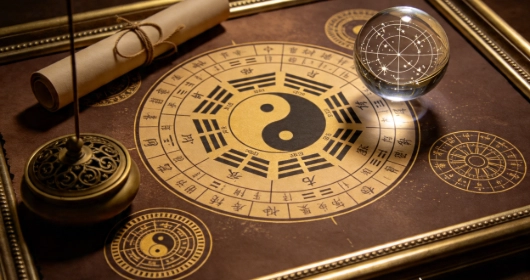
BaZi Astrology
Feel Stuck Every 10 Years? BaZi Luck Cycles Explained

Do you know that feeling? Waking with a stone on your chest, weary for no reason, unable to muster motivation. Or a voice in your head that won't stop — criticizing, picking apart every move, leaving you tangled in anxiety. You might even wonder: "Have I fallen ill?"
What you're experiencing may be a completely normal part of your life's natural energy cycles — not a permanent state.
Before drawing conclusions, consider a different lens. It comes from an ancient Eastern wisdom: BaZi (八字), or the Four Pillars of Destiny. It might reveal you're not "ill" — you may have simply entered the "winter" of your personal energy cycle.



Just as nature has seasons, our lives are believed to have energetic seasons. In BaZi, these are your "Da Yun" (大运), the 10-year chapters of your life, and your "Liu Nian" (流年), the annual energy "weather." This framework suggests nearly 40% of people are in an emotional low tide governed by these cycles at any time. You are not strange. You are not alone.
Understanding Energy Cycles: The Natural Flow
What Are Da Yun (10-Year Cycles)?
Think of your life as a book. Your birth BaZi chart is the table of contents, and "Da Yun" are the chapters. Each chapter lasts about ten years and represents a complete phase:
- Supportive Da Yun — Smooth progress, character growth, things flow naturally
- Challenging Da Yun — Conflicts, character tests, requiring more effort
- Transitional Da Yun — Plot twists, ending old chapters, preparation for new beginnings
What Are Liu Nian (Yearly Influences)?
If Da Yun are chapters, then "Liu Nian" are paragraphs. Each year has its unique energy quality — some years support your growth, some bring challenges and reflection, some are transitional.
Key Insight: No chapter is permanent. Every Da Yun ends, and a new chapter begins.
7 Classic Patterns of "Emotional Weather"
You might be experiencing one of these patterns:
1. Mental Fog, Lost Joy — Possibly "Xiao Shen Duo Shi" (枭神夺食)
This isn't about becoming slow or negative. In your BaZi chart, the part representing thought, creativity, and joy — the "Shi Shen" (食神) or "Eating God" — might be smothered by an overbearing, "protective" energy: the "Yi Yin" (枭神) or "Resource Star."
It's like a tree choked by vines, unable to sprout. Forcing yourself to "think positive" drains you further. True self-care is permission to pause — to receive input without forcing output.
👉 Check your element balance to see where your energy stands.
2. The Inner Critic at Full Volume — Possibly "Yin Zhi Shang Guan" (印制伤官)
That blaming, stifling voice may correspond to your "Shang Guan" (伤官) or "Hurting Officer" (governing talent, expression, desire) being suppressed by your "Zheng Yin" (印星) or "Printing Star" (governing morality, duty, the "superego").
This is an internal trial by your "morality police," not an external conflict. Expression is preempted by "this isn't right," turning energy inward. Don't rush to prove yourself. A private journal is a safe pressure valve.
3. Feeling Frayed, Anxious — Possibly "Jin Ke Mu Tai Guo" (金克木太过)
In BaZi's Wu Xing (五行) or Five Elements, the Wood element (木) governs the liver, gallbladder, and nervous system — like a tree's trunk, responsible for growth. If your Wood is inherently weak or you enter a year of strong Metal (金) energy (which controls Wood), it's like a sapling facing metal shears.
You feel inexplicably tense, worried, rigid. This isn't weakness; it's your "energetic root system" under pressure. Walking, stretching, and time in nature fortify that swaying sapling.
4. The Overactive Creative Center — Excessive "Shang Guan" (伤官)
Creativity becomes endless brainstorming — too many ideas, too little execution, leading to frustration and self-criticism.
Remember: When the energy cycle shifts, this creative force will find proper outlets. What you need now is patience, not forced production.
5. Joy System "Switched Off" — Temporary Neurochemical Adjustment
The ability to feel joy temporarily "turns off." Good things happen, but you can't feel happiness.
Remember: This is a temporary neurochemical adjustment period. Like a phone needing reboot, your joy system is recalibrating. Don't force yourself to "be happy" — that just adds pressure.
6. The "Fog Zone" Between Da Yun Transitions
- Confusion about life direction
- Doubts about past choices
- Uncertainty about the future
- Increased emotional fluctuations
Professional Perspective: In BaZi, the 1-2 years before and after a Da Yun change is called the "transition period." It's like the unpredictable weather between seasons — not quite winter, not quite spring. This is a completely normal transitional phenomenon. Once fully in the new Da Yun, clarity and direction naturally return.
7. When External Pressure Triggers Internal Conflict
Internal debates become heated arguments. Every decision feels like the wrong choice.
Remember: The intensity of conflict correlates with external pressure. When life stabilizes, this inner conflict naturally diminishes. For now, accept that decision-making difficulty is a normal response, don't overanalyze.
BaZi: The Framework for Contextual Comfort
A BaZi practitioner, reading your chart, might point to a transit and say: "Don't worry unduly. You're in a specific Da Yun or Liu Nian. This energy field is causing a strong reaction. After passing a certain nodal point, this tightening will naturally loosen."
The Profound Value: It Dispels the Unknown
Our deepest fear is often not the pain itself, but not knowing where it comes from or when it will end. That sensation of a boundless, horizonless low or anxiety infinitely amplifies helplessness. What BaZi provides is precisely an explanatory system and a temporal framework.
It answers the "Why?" It redirects the struggle toward a temporary, external "energetic climate" (e.g., Yin Zhi Shang Guan), rather than a permanent, internal "character flaw." This can lift the boulder of self-attack, transforming the panic of "Am I broken?" into the understanding of "Ah, I'm experiencing a specific type of 'weather.'" Understanding the cause is the beginning of healing.
It Sketches a "Timeline"
This is perhaps BaZi's most precious gift — the concept of a foreseeable cycle. It may not be precise to the day, but it outlines a meaningful timeframe. Knowing the low tide has a "duration," knowing winter "will pass" — this expectation of an end is, in itself, a powerful sedative and a wellspring of hope. It turns an endless dark tunnel into a passage with a limit, with a faint light discernible at the end.
Cultivating Heart and Acceptance: Wisdom for Emotional Winters
Phase 1: Recognize the Season
- Tell yourself: "This is a temporary energy cycle"
- Observe without judgment: "Hmm, the depressive feeling is here again today"
- Track patterns: Notice emotions have ups and downs, not just decline
Phase 2: Adjust Expectations
- Basic self-care first: Sleep, nutrition, gentle movement
- Lower achievement standards: Celebrate completing small tasks
- Reduce major decisions: Postpone important life changes unless necessary
- Allow "just being": Sometimes living is achievement enough
Phase 3: Prepare for Transition
- Starting to have vivid dreams
- Renewed curiosity about certain things
- Small natural increases in energy
- Beginning to feel "tired of" the depressed state itself
When you notice these signs, don't rush to push forward. Like spring arriving, new growth emerges naturally.
Professional Tools: Identifying Your Current Cycle
Self-Help Methods:
- Review patterns — When did you last feel "stuck"? How long? How did it end?
- Track triggers — What situations make emotions lower? Any seasonal patterns?
- Observe natural cycles — Do emotions correlate with moon phases or seasonal changes?
Value of Professional Analysis:
- Determine your current Da Yun's nature
- Identify years that trigger sensitive patterns
- Approximate timing of energy shifts
- Provide targeted balancing suggestions
👉 Try our free BaZi calculator to explore your chart and see which element needs balancing.
Final Wisdom: Your Low Point is Your Depth
The deepest comfort of BaZi may not lie in "predicting" specific events, but in providing a "navigational chart" and "weather forecast" for the inner storms. It tells you that the turbulent waves you face are likely just a stage-specific squall while crossing a particular stretch of sea, not the eternal state of the ocean itself.
When a person's mindset shifts from the ultimate fear of "Will I ever feel better?" to the knowing of "This is my Geng Zi (庚子) year; the Qi field will shift after the solar term of 'Spring Commences (立春)'", a sense of inner sovereignty and patience quietly takes root.
Winter never asks the tree why it sheds its leaves; it silently completes the change of seasons. Your spring is already written into the rhythm of these cycles.
The earth moves through seasons, and so do our inner lives — this is the insight from the Blossom and the Fruit.
Note: This information combines traditional wisdom with modern understanding, offering an additional perspective. If experiencing significant depression, please seek professional mental health support. BaZi perspective complements rather than replaces traditional treatment.
Where you are now, however dark it feels, isn't your story's end. It might be your most important chapter — where the protagonist faces deepest fears, releases heaviest burdens, discovers true strength.
Accepting this season is accepting your whole self. Heart cultivation isn't passive endurance — it's active choice: choosing not to sail in storms, choosing to rest well in winter, choosing to trust spring will come.
Because according to 2,000 years of observation, energy always shifts, seasons always change, dawn always follows night. This isn't blind optimism — it's how the universe operates.
Everything you're feeling now — confusion, sadness, weakness, doubt — proves your humanity's depth, signals your soul undergoing important transformation. Allow yourself to fully experience this cycle. No rush, no pretense. When the time comes, you'll know. Because you'll feel something inside ready — not forced, but naturally matured — to break through soil, growing toward light.
Then, looking back, you'll understand: This low point wasn't where you fell — it was where you discovered you could fly.
Frequently Asked Questions
How long do BaZi emotional low periods last?
Challenging Da Yun (10-year cycles) typically last 7-10 years, but the most intense phases usually concentrate in the middle 3-4 years. Within each year, triggering months are shorter still. The key insight: nothing is permanent.
Does BaZi replace therapy or medication?
Not at all. Think of BaZi cycles as the 'weather system,' therapy as 'learning to walk in rain,' and medication as 'rain gear.' They work together. BaZi adds an understanding of timing — knowing whether you're in an emotional 'winter' helps set realistic expectations and reduces self-blame.
Can I speed up a difficult luck cycle?
You can't force energy cycles to change, but you can prepare. Rest well, learn new skills, process unresolved emotions. When the next cycle arrives, those with prepared foundations benefit most.
Does everyone experience challenging luck cycles?
Yes. According to BaZi theory, almost everyone has at least one major challenging 10-year period in their lifetime, plus annual fluctuations. Even highly successful people describe similar 'dark periods' — the difference is understanding that it's part of a cycle, not a permanent state.
How do I know if I'm in a low-energy cycle?
Common signs: waking with unexplained heaviness, loss of interest in things you usually enjoy, mental fog, inner criticism becomes louder, feeling emotionally 'frayed' without clear reason. A BaZi reading can confirm which cycle you're in and when energy naturally shifts.