Home Feng Shui
Desk Feng Shui 101: Boost Your Career
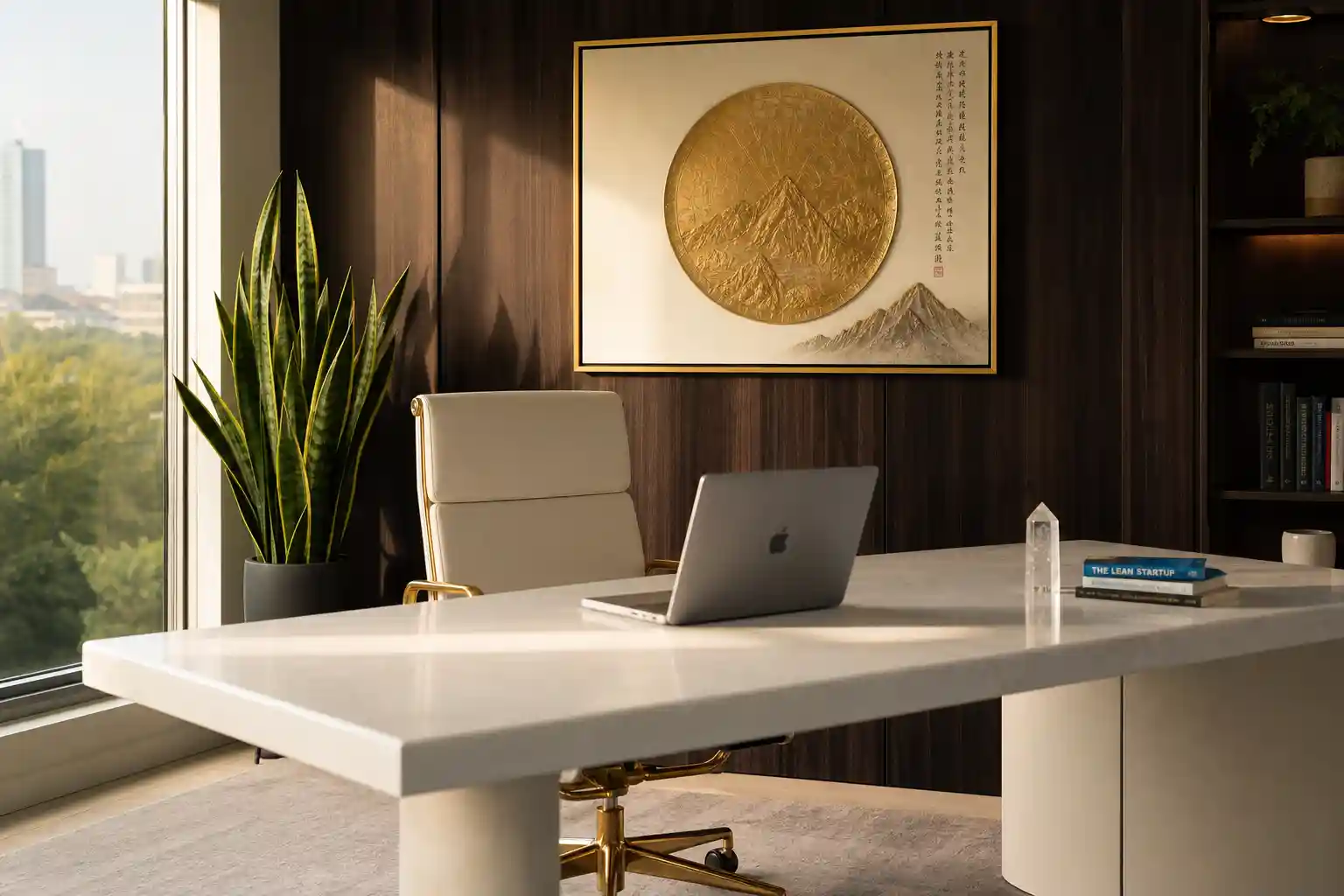
Your desk position affects your career energy more than you think. In feng shui, the "command position" — sitting with a solid wall behind you and a clear view of the door — creates a sense of control and authority. Research on workspace psychology (Harvard Business Review, 2023) confirms that seat position affects perceived authority and focus. Use our free BaZi calculator to find your personal lucky direction beyond generic feng shui rules.
What Is the Command Position?
The command position (also called the "power position") is the single most important concept in feng shui desk placement. It comes from ancient Chinese military strategy: a general always sits where they can see the entire battlefield, with their back protected by mountains.
Three conditions must be met:


- Solid wall behind you — symbolizes support, "backing," and stable career foundation
- Facing the door (but not directly in line with it) — you see opportunities coming, but aren't directly hit by rushing energy
- Clear view of the room — you aren't surprised from behind; you have psychological control over your space
Modern translation: In workspace psychology, this is called "prospect-refuge theory." Humans perform best when they can see the entrance but aren't directly exposed to it. A 2023 study in the Journal of Environmental Psychology found that employees with their backs to the door reported 23% higher cortisol levels (chronic stress) than those with a wall behind them.
If you can't achieve perfect command position (most offices don't allow it), prioritize in this order:
- ✅ Solid wall behind you (non-negotiable)
- ✅ Ability to see the door (use a small mirror if needed)
- ⚠️ Not directly in line with the door (diagonal is fine)
4 Desk Placement Rules That Matter
1. Never sit with your back to the door
This is the #1 mistake. When your back faces the door, your nervous system stays in low-grade "threat mode" — you can't fully relax or focus. In feng shui, this is called "backing no support" (无靠).
The fix: If you can't move your desk, add a high-backed chair, a cushion, or even a small "wall" (bookshelf behind your chair). In a pinch, wear a suit jacket with a high collar — it creates a psychological "shield."
2. Avoid the "coffin position" (directly facing a wall)
Sitting facing a blank wall with no space to look into the room creates "stuck" energy. Your career feels blocked, promotions stall, and motivation drops.
The fix: If you must face a wall, hang a landscape painting or mirror on it. The mirror expands the space visually; the landscape gives your eyes a "distance" to look into. Best choice: a painting of water flowing toward you (symbolizes wealth flowing in).
3. Desk shape matters: curves > sharp corners
L-shaped desks are ideal (symbolizes "embracing" opportunities). Rectangular desks are fine. Avoid desks with sharp corners pointing at you (creates "poison arrow" or sha qi).
The fix: If your desk has sharp corners, place a small round plant or a ceramic mug at the corner to "soften" it.
4. Keep the left side ("dragon side") higher than the right
In traditional feng shui, the left side represents the "dragon" (career power, male energy, active growth). The right side is the "tiger" (relationships, support, passive energy). For career advancement, keep your left side slightly "heavier" — a taller lamp, a stack of books, or a plant.
Modern interpretation: This is similar to the "left-side dominance" principle in visual design. A slightly asymmetric layout feels more dynamic and "active" than a perfectly symmetric one.
Your Personal Direction: Kua Number
Generic feng shui rules (like "north is good for career") ignore your personal energy. In BaZi and Eight Mansion Feng Shui, your Kua number determines your personal lucky directions.
How to find it (quick version):
- Born 1984, 1993, 2002, 2011 (or any year ending in 4, 3, 2, 1): East Group → your lucky desk direction is east, southeast, south, or north
- Born 1985, 1994, 2003, 2012 (or any year ending in 5, 6, 7, 8, 9, 0): West Group → your lucky desk direction is west, northwest, southwest, or northeast
Don't guess — calculate exactly. Use our free BaZi calculator to get your exact Kua number and personal lucky direction. It takes 2 minutes and tells you which way to face for career luck.
Why it matters: A friend of mine (born 1987, West Group) insisted on facing east because "east is the sunrise, must be good." Within 3 months of switching her desk to face northwest (her personal lucky direction), she got promoted. Coincidence? Maybe. But when energy aligns with your personal chart, things flow differently.
5-Minute Desk Feng Shui Audit
Do this right now (takes 5 minutes):
- Check your back — is there a solid wall? If not, add a high-backed chair or cushion ✅/❌
- Check your view — can you see the door? If not, add a small mirror ✅/❌
- Check your left side — is it slightly "heavier" than the right? Add a plant or lamp ✅/❌
- Check your Kua number — are you facing your personal lucky direction? Calculate it here ✅/❌
- Check your desk surface — is it cluttered? Clear the center 20cm for "energy flow" ✅/❌
Score: 5/5 = your desk is feng shui-perfect. 3/5 or below = make the fixes above this week.
FAQ: Desk Feng Shui Questions Answered
Q: Where should I face my desk for career luck? A: Face your personal lucky direction based on your Kua number (East or West group). If you don't know your Kua number, sit in the command position: facing the door at an angle, with a solid wall behind you.
Q: Why is desk facing the door bad in feng shui? A: A desk directly facing the door creates "rushing energy" (chong sha) — you're exposed and vulnerable. The fix: place your desk diagonally from the door, not in direct line with it.
Q: What is the command position for desk placement? A: Command position = sitting with a solid wall behind you (support), facing the door but not directly in line with it (awareness without exposure), and having a clear view of the room (control).
Q: Can feng shui desk placement really affect my career? A: While scientific evidence is limited, many professionals report improved focus and confidence after adjusting their desk position. The psychological effect of feeling "supported" by a solid wall is well-documented in workspace research.
Q: What if I can't move my desk at work? A: Use workarounds: add a high-backed chair or cushion for 'wall support,' place a small mirror to see the door, or add a plant to the left side for growth energy. Small adjustments still help.
The BaZi Connection: Why Your Desk Direction Isn't Enough
Feng shui desk placement is the "external" fix. But your personal energy (your BaZi chart) determines whether career luck flows for you in the first place.
Two people can have identical desk setups — one gets promoted within 6 months, the other feels stuck. The difference? Their Day Master element, their 10-year luck cycles, and whether their current year supports their career element.
Next step: After fixing your desk, calculate your BaZi chart free. Find out:
- Which element your career palace needs (Water? Wood? Metal?)
- Whether your current 10-year cycle supports career growth
- Which years are your "breakthrough" years (and which to lie low)
Desk feng shui + BaZi timing = career luck you can actually work with.
Written by Xuanzhen, DaoEssence founder. Combining traditional BaZi & feng shui with modern workspace psychology.
Frequently Asked Questions
Where should I face my desk for career luck?
Face your personal lucky direction based on your Kua number (East or West group). If you don't know your Kua number, sit in the command position: facing the door at an angle, with a solid wall behind you.
Why is desk facing the door bad in feng shui?
A desk directly facing the door creates 'rushing energy' (chong sha) — you're exposed and vulnerable. The fix: place your desk diagonally from the door, not in direct line with it.
What is the command position for desk placement?
Command position = sitting with a solid wall behind you (support), facing the door but not directly in line with it (awareness without exposure), and having a clear view of the room (control).
Can feng shui desk placement really affect my career?
While scientific evidence is limited, many professionals report improved focus and confidence after adjusting their desk position. The psychological effect of feeling 'supported' by a solid wall is well-documented in workspace research.
What if I can't move my desk at work?
Use workarounds: add a high-backed chair or cushion for 'wall support,' place a small mirror to see the door, or add a plant to the left side for growth energy. Small adjustments still help.