BaZi Astrology
Five Elements Body Type: What BaZi & TCM Reveal About Your Health
Why do two people eat the same cold food, but one gets a stomachache while the other feels fine? Why does one person catch every flu going around, while another seems immune?
The answer isn't just "strong immunity" or "weak constitution." It's more specific than that. Your body has a natural tendency — a default setting — that determines which systems run strong and which ones crack under pressure first.
This idea isn't new. Over 2,000 years ago, Chinese medicine mapped it out in detail using the Five Elements framework. And your BaZi birth chart — the four pillars calculated from your birth date and time — can tell you which element dominates your constitution.


Here's the practical version: no mysticism, no vague fortune-telling. Just a framework for understanding why your body behaves the way it does — and what you can actually do about it.
Where This System Comes From
Two books built the foundation.
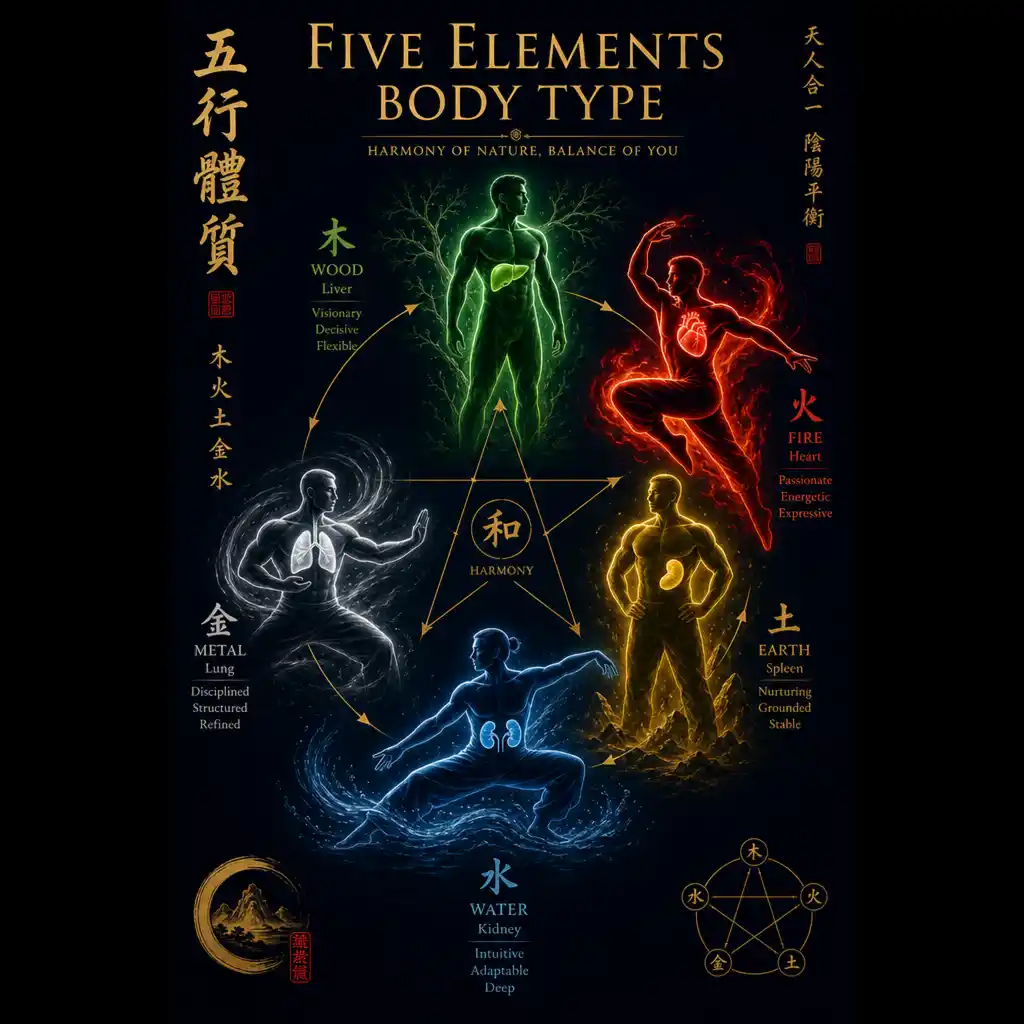
The first is the Huangdi Neijing (《黄帝内经》, Yellow Emperor's Classic of Internal Medicine), compiled around 200 BCE. Its chapter called "Yin Yang Twenty-Five People" (阴阳二十五人) classified every human into five body types based on the Five Elements — Wood, Fire, Earth, Metal, Water — then subdivided each type into five variants, giving 25 distinct constitutional profiles. Each profile included physical appearance, personality tendencies, and which seasons made that person most vulnerable to illness.
The second is the BaZi system itself, which uses your birth data to calculate the elemental balance at the exact moment you were born. Classical BaZi texts like the Di Tian Sui (《滴天髓》) and San Ming Tong Hui (《三命通会》) have dedicated chapters on how elemental imbalances in your chart correspond to specific health vulnerabilities.
These aren't separate systems. They share the same root theory: the Five Elements interact with your organs, emotions, body tissues, and seasonal environment in predictable ways.
"五行和者寿,偏枯者疾。" —《滴天髓》(Di Tian Sui)
In plain language: when the Five Elements in your chart are balanced, you tend to be healthier. When one element is extremely strong or extremely weak, the corresponding organ system is where problems show up first.
In modern times, this framework has been validated and refined. Professor Wang Qi (王琦) developed the Nine Body Constitution system, which became China's national standard (GB/T 30338-2013) for TCM constitution classification. His team surveyed over 60,000 people across the country and confirmed that most people can be clearly categorized — and that each category has distinct, predictable health patterns.
The Five Body Types: Which One Are You?
Let's skip the classical Chinese descriptions that read like poetry and get straight to what you can observe in the mirror.
Wood Type (木型人)
What you look like: Tall or above average height, straight posture, broad shoulders, long face, slim build. Your fingers tend to be long. Skin may have a slightly greenish or olive undertone. You look like someone who'd do well in athletics — lean and wiry rather than bulky.
How you think and act: You're idea-driven. Creative, ambitious, always planning the next thing. You get frustrated easily when things don't move fast enough. Stress shows up as irritability — you might clench your jaw or get headaches when things pile up.
Where your body is vulnerable: Your liver and gallbladder are your weak points. In TCM, the liver governs the smooth flow of energy (qi) throughout the body. When you're chronically stressed or angry, TCM says your "liver qi stagnates" — and modern medicine would recognize this as the stress-hormone cascade that affects digestion, sleep, and immune function. Common issues: headaches, eye strain, tendon problems, insomnia from overthinking.
Seasonal pattern: You handle spring and summer well. Autumn and winter — especially cold, dry weather — tend to make you feel worse.
"木形之人…好有才,劳心,少力,多忧劳于事…能春夏不能秋冬。" —《灵枢·阴阳二十五人》
Translation: Wood-type people are talented but tend to overwork their minds, worry a lot, and handle spring/summer better than autumn/winter. Sound familiar?
Fire Type (火型人)
What you look like: Medium height, pointed face shape, reddish or flushed complexion. Your shoulders and back tend to be muscular. You move quickly — fast walker, fast talker, fast thinker. Small hands and feet relative to your body.
How you think and act: You're the life of the room. Enthusiastic, passionate, expressive. But you also burn out fast. You might start projects with huge energy and lose interest quickly. You're generous with money and attention but can be impulsive. Under stress, you get anxious or have trouble sleeping — your mind won't shut off.
Where your body is vulnerable: Heart and cardiovascular system. TCM links Fire to the heart, blood vessels, and the tongue. When Fire is excessive, you get symptoms like mouth ulcers, restlessness, heart palpitations, and inflammation. When Fire is weak, you feel emotionally flat, have poor circulation, and look pale.
Seasonal pattern: Summer is your power season. Winter is when you struggle most — cold weather hits you harder than others.
"火形之人…有气轻财,少信,多虑,见事明,急心,不寿暴死。能春夏不能秋冬。" —《灵枢·阴阳二十五人》
Translation: Fire-type people are energetic, generous but impulsive, perceptive but anxious. They thrive in warm weather and are vulnerable in cold. The classical text's dramatic "不寿暴死" (risk of sudden health events) is referring to cardiovascular risk when Fire is severely imbalanced — not a death sentence.
Earth Type (土型人)
What you look like: Solid, well-built, often with a rounder face and larger head. You carry weight easily — not necessarily overweight, but you have a substantial physical presence. Good muscle-to-bone ratio. Your lips tend to be full, and your complexion leans yellow or warm-toned.
How you think and act: You're the reliable one. Calm, patient, good at nurturing others. You think before you act and prefer stability over excitement. Your downside: you tend to overthink and worry. When stressed, you might eat more or withdraw socially. You're the friend everyone comes to for advice, but you rarely ask for help yourself.
Where your body is vulnerable: Spleen and stomach — your digestive system. TCM considers the spleen (which in TCM includes the pancreas and parts of the digestive process, not just the anatomical spleen) as the center of transforming food into energy. When Earth is imbalanced, you get bloating, fatigue after meals, loose stools, weight gain, and that "heavy" feeling. Dampness — TCM's term for metabolic sluggishness — is your biggest enemy.
Seasonal pattern: Late summer and the transitional periods between seasons are your time. Spring — especially windy, changeable weather — tends to throw you off.
"土形之人…圆面大头,美肩背,大腹,美股胫…安心,好利人,不喜权势,善附人也。能秋冬不能春夏。" —《灵枢·阴阳二十五人》
Translation: Earth-type people have round faces, solid builds, and big bellies. They're calm, generous, good at supporting others, and not interested in power. They handle autumn/winter well but struggle in spring/summer transitions.
Metal Type (金型人)
What you look like: Square-shaped face, relatively small head and frame. Your bone structure is prominent — you can see it in your cheekbones, jawline, or hands. Skin tends to be fair or pale. You might have a voice that carries — clear and authoritative. Overall, you look "refined" rather than rugged.
How you think and act: You're organized, disciplined, and detail-oriented. You have strong opinions about right and wrong, and you hold yourself to high standards. You're the person who makes plans and actually follows through. The shadow side: you can be rigid, perfectionist, and prone to sadness or grief when things don't go as planned. You might hold onto grudges longer than you'd like to admit.
Where your body is vulnerable: Lungs and respiratory system. TCM links Metal to the lungs, large intestine, skin, and nose. When Metal is imbalanced, you get dry skin, constipation, allergies, asthma, or frequent colds. Emotionally, grief and sadness are the feelings that hit your system hardest — TCM literally says "grief damages the lungs" (忧伤肺).
Seasonal pattern: Autumn is when you feel most alive — crisp air, clear skies. Late summer and damp heat make you feel sluggish.
"金形之人…方面白色,小头小肩背小腹…清廉,急心,静悍,善为吏。能秋冬不能春夏。" —《灵枢·阴阳二十五人》
Translation: Metal-type people have square faces, fair skin, and a compact build. They're principled, determined, and naturally good at management roles. They thrive in autumn/winter and struggle in spring/summer.
Water Type (水型人)
What you look like: Softer, rounder body shape. You gain weight easily, especially around the midsection and lower body. Your face may have uneven contours, and your complexion tends toward darker or duller tones. You move with a certain heaviness — not lazy, just grounded.
How you think and act: You're the strategist. Deep thinker, good at reading people and situations. You prefer to observe before acting, and when you do act, it's calculated. You're adaptable and resourceful. Under stress, you tend to withdraw, become fearful, or overthink. You might struggle with motivation during certain periods — not laziness, but a deep sense of "what's the point."
Where your body is vulnerable: Kidneys and urinary system. TCM considers the kidneys the root of all energy — they store your "prenatal qi" (the energy you were born with). When Water is imbalanced, you get lower back pain, knee weakness, tinnitus, frequent urination, cold hands and feet, and low libido. TCM says "fear damages the kidneys" (恐伤肾) — chronic anxiety or feeling unsafe literally depletes your deepest energy reserves.
Seasonal pattern: Winter is paradoxically both your season and your danger zone. You're adapted to cold, but extreme cold overloads your system. Summer heat can also be hard on you because your body struggles with temperature regulation.
"水形之人…黑色,面不平,大头,廉颐,小肩大腹…不敬畏,善欺给人…能秋冬不能春夏。" —《灵枢·阴阳二十五人》
Translation: Water-type people have darker skin, uneven facial contours, large heads and bellies. They're clever and strategic but can be manipulative. The classical text is blunt — it's describing tendencies, not moral judgments.
Quick Self-Test: Which Type Are You?
Not sure which type matches you? Most people are a mix, but one usually dominates. Check the boxes that apply:
| Feature | Wood | Fire | Earth | Metal | Water |
|---|---|---|---|---|---|
| Tall, slim build | ✓ | ||||
| Pointed face, flushed skin | ✓ | ||||
| Solid, round build | ✓ | ||||
| Square face, prominent bones | ✓ | ||||
| Soft, round body | ✓ | ||||
| Gets irritated under stress | ✓ | ||||
| Burns out fast, anxious | ✓ | ||||
| Overthinks, worries | ✓ | ||||
| Perfectionist, holds grudges | ✓ | ||||
| Withdraws when stressed | ✓ | ||||
| Headaches, eye strain | ✓ | ||||
| Heart palpitations, insomnia | ✓ | ||||
| Bloating, fatigue after meals | ✓ | ||||
| Dry skin, constipation, allergies | ✓ | ||||
| Lower back pain, cold hands/feet | ✓ |
How Your BaZi Chart Determines Your Body Type
Here's where it gets personal. Your Five Elements body type isn't random — according to classical theory, it's encoded in your birth data.
Step 1: Find Your Day Master
In BaZi, your Day Master (日主) is the Heavenly Stem of your birth day. It's the single most important element in your chart — it represents you.
| Day Master | Element | Body Type Tendency |
|---|---|---|
| 甲 (Jiǎ) | Yang Wood | Classic Wood type — tall, straight, strong-willed |
| 乙 (Yǐ) | Yin Wood | Softer Wood type — flexible, wiry, creative |
| 丙 (Bǐng) | Yang Fire | Blazing Fire type — energetic, warm, intense |
| 丁 (Dīng) | Yin Fire | Gentle Fire type — bright but not overwhelming |
| 戊 (Wù) | Yang Earth | Mountain Earth type — solid, dependable, heavy |
| 己 (Jǐ) | Yin Earth | Garden Earth type — nurturing, soft, fertile |
| 庚 (Gēng) | Yang Metal | Sword Metal type — sharp, disciplined, rigid |
| 辛 (Xīn) | Yin Metal | Jewelry Metal type — refined, sensitive, precise |
| 壬 (Rén) | Yang Water | Ocean Water type — vast, adaptable, deep |
| 癸 (Guǐ) | Yin Water | Rain Water type — gentle, penetrating, intuitive |
Find your Day Master in 2 minutes →
Step 2: Check the Season You Were Born In
Your Day Master tells you your base element. But the month you were born in determines whether that element is strong or weak — which directly affects your health tendencies.
Here's the logic: each season amplifies one element and suppresses another.
| Season | Strong Element | Weak Element | What This Means |
|---|---|---|---|
| Spring (Feb–Apr) | Wood | Metal | Wood types born in spring are extra strong; Metal types are extra weak |
| Summer (May–Jul) | Fire | Water | Fire types thrive; Water types struggle |
| Late Summer (Jul–Aug) | Earth | Wood | Earth types are at their peak; Wood types feel drained |
| Autumn (Sep–Nov) | Metal | Wood | Metal types feel great; Wood types get stressed |
| Winter (Dec–Jan) | Water | Fire | Water types are energized; Fire types feel depleted |
Example: If you're a 甲木 (Yang Wood) Day Master born in September (autumn, Metal season), Metal chops Wood — your liver and gallbladder are your先天 (innate) weak points. You might notice that stressful periods in autumn hit your energy harder than other seasons.
This isn't speculation. The Qiong Tong Bao Jian (《穷通宝鉴》), a classical BaZi text from the Qing Dynasty, systematically analyzes each Day Master's strengths and weaknesses across all twelve months. Its core principle: the month of birth determines whether your element is thriving or struggling — and that maps directly to your health baseline.
Step 3: Look at the Overall Balance
Your Day Master and birth month give you the big picture. But the full chart — all four pillars (year, month, day, hour) — reveals the complete elemental balance.
"木盛金衰,木多火炽;火炎土燥,土重金埋;金寒水冷,水泛木浮。" —《滴天髓》(Di Tian Sui)
Translation: when one element is overwhelmingly strong and its counterbalancing element is weak, the imbalance creates specific health patterns. Too much Wood with too little Metal? Liver problems. Too much Fire drying out the Earth? Digestive issues. Too much Water flooding the system? Kidney and lower back problems.
The San Ming Tong Hui (《三命通会》) puts it even more directly:
"凡看疾病,以日干为主。日干属木,被金克者,主肝胆之疾。" —《三命通会·论疾病》
Translation: when diagnosing health from a BaZi chart, start with the Day Master. If your Day Master is Wood and Metal is attacking it in your chart, liver and gallbladder issues are the primary concern.
Important caveat: BaZi reveals tendencies, not destiny. Having a weak element in your chart doesn't mean you'll definitely get sick — it means that system needs more attention and care than your naturally strong systems. Think of it like knowing your car's weak spot: you don't crash because you know it, you maintain it better.
When Your Luck Cycle Shifts, Your Health Shifts Too
Here's something that catches people off guard: your health doesn't stay at the same baseline forever. Every 10 years, you enter a new Da Yun (大运, Major Luck Cycle), and each cycle activates different elemental interactions in your chart.
This is why people often say things like "I never had health problems until my mid-30s" or "Since I turned 40, everything started going wrong." It's not just aging — it's your luck cycle moving into a phase that clashes with a weak element in your birth chart.
How it works:
- If your birth chart has weak Wood (liver tendency), and your current 10-year cycle brings strong Metal energy, that Metal will attack your already-weak Wood. This is when liver-related issues are most likely to surface.
- Conversely, if your cycle brings Water energy, Water feeds Wood — your liver gets support, and you might feel surprisingly healthy even if your chart suggests vulnerability.
The practical takeaway: know your weak element, and pay extra attention during luck cycles that bring its opposing element. For a deeper dive into how these 10-year cycles work, check our complete guide to BaZi luck cycles.
What to Do About It: Practical Wellness by Type
Knowing your body type is only useful if it changes what you actually do. Here's a practical guide for each type.
Wood Type Wellness
Diet: Focus on green, leafy vegetables (spinach, broccoli, celery). Sour flavors in moderation support the liver — a squeeze of lemon in warm water each morning is a simple habit. Avoid excessive alcohol, which TCM considers the biggest liver stressor.
Movement: You need physical exercise to move stagnant liver qi. Running, swimming, or brisk walking work well. Yoga is excellent for the tendon flexibility that Wood types need.
Emotional care: Your biggest health risk isn't food — it's stress. Chronic anger and frustration literally damage your liver in TCM theory (怒伤肝). Find a stress outlet that works: meditation, journaling, talking to someone. This isn't woo-woo — chronic stress elevates cortisol, which impairs liver function by any medical framework.
Environment: Green and blue-green colors support you. Check our Five Elements wallpaper guide for phone wallpapers that match your element.
Fire Type Wellness
Diet: Cooling foods are your friend — cucumber, watermelon, bitter melon, mint tea. Avoid too much spicy food and caffeine, which add fuel to your already-hot system. Bitter flavors support the heart in moderation.
Movement: Cardiovascular exercise is essential — but don't overdo it. Moderate jogging, cycling, or dancing keep your heart strong without burning you out. Swimming is ideal because the water element balances your fire.
Emotional care: Your challenge is learning to slow down. Anxiety and over-excitement both disturb your heart energy (喜伤心 — yes, even excessive joy). Calming practices like deep breathing or gentle meditation before bed help with the insomnia that Fire types are prone to.
Environment: Red and warm tones energize you, but if you're already feeling wired, cool blues and blacks can help balance. For personalized color guidance, see our 2026 lucky colors guide.
Earth Type Wellness
Diet: Your digestive system needs warmth and regularity. Eat at consistent times — skipping meals is worse for you than for other types. Warm, cooked foods (soups, stews, congee) are ideal. Sweet flavors support the spleen — think sweet potato, pumpkin, dates, and rice. Avoid cold, raw foods and excessive dairy, which create "dampness" (that bloated, heavy feeling).
Movement: You benefit from steady, moderate exercise — walking, tai chi, light weight training. Avoid extreme workouts that leave you exhausted. The key is regular practice, not intensity.
Emotional care: Your tendency to overthink and worry creates a feedback loop that weakens your digestion (思伤脾 — overthinking damages the spleen). When you catch yourself spiraling into worry, physical movement breaks the cycle — even a 10-minute walk helps.
Environment: Yellow, brown, and earth tones ground you. These colors in your living space and on your phone screen serve as subtle anchors for your digestive energy.
Metal Type Wellness
Diet: Your lungs and skin need moisture. Pears, lily bulb, honey, and white fungus (银耳) are classic TCM lung-nourishing foods. Pungent flavors in moderation support the lungs — ginger tea, radish, and mild peppers help clear congestion. Avoid smoking and excessive dry, fried foods.
Movement: Breathing exercises are especially powerful for you. Qi gong, pranayama, or even simple deep-breathing routines directly support your weakest system. Outdoor walks in fresh air — especially in autumn — are rejuvenating.
Emotional care: Sadness and mourning are the emotions that hit your system hardest (忧伤肺). If you tend to hold onto past hurts or fall into melancholy, this isn't just a personality trait — it's a health factor. Therapy, journaling, or talking things through aren't luxuries for Metal types; they're maintenance.
Environment: White, silver, and metallic colors resonate with your element. Clean, minimalist spaces help you feel balanced — clutter actually weighs on your energy.
Water Type Wellness
Diet: Your kidneys need warmth and nourishment. Black beans, walnuts, sesame seeds, bone broth, and seaweed are excellent. Salty flavors in moderation support the kidneys — but most people get too much salt, not too little. Avoid ice-cold drinks and raw foods, which deplete your kidney yang (the warming fire that powers your metabolism).
Movement: You need gentle, warming exercise. Walking, swimming (in warm water), and tai chi work well. Avoid overtraining — Water types tend to push until they crash, then struggle to recover. Rest days are non-negotiable.
Emotional care: Fear and anxiety are your kryptonite (恐伤肾). Chronic insecurity or feeling unsafe drains your deepest energy reserves. Building a sense of stability — through routine, supportive relationships, and safe living spaces — is health care for Water types, not just lifestyle advice.
Environment: Black and deep blue colors support you. Warm, well-insulated living spaces matter more for you than for other types. In winter, keep your lower back and feet warm — this is where cold attacks your kidney energy first.
The Bigger Picture: Your Body Type Is a Map, Not a Sentence
Here's what we want to be clear about: knowing your Five Elements body type doesn't mean you're doomed to get the diseases associated with it. It means you have insider information about where your body is naturally strong and where it needs extra support.
Think of it this way: if you know your car's transmission is its weak point, you don't drive it into a wall — you get the transmission checked more often, change the fluid regularly, and drive more carefully on steep hills. Same principle.
The Five Elements framework gives you three things:
- Self-awareness — understanding why your body reacts the way it does
- Timing — knowing which periods in your life are harder on your system (through luck cycles)
- Action — specific dietary, lifestyle, and environmental adjustments that support your weak points
If you haven't checked your BaZi chart yet, that's the place to start. Your Day Master reveals your core element, and the overall chart shows where your strengths and vulnerabilities lie.
Generate your free BaZi chart →
Frequently Asked Questions
What are the Five Elements body types?
The Five Elements body types — Wood, Fire, Earth, Metal, and Water — are a classification system from Traditional Chinese Medicine that links your physical constitution, personality traits, and health tendencies to one of the five elemental energies. This system was first documented in the Huangdi Neijing (Yellow Emperor's Classic) over 2,000 years ago, and has been refined through both classical BaZi analysis and modern TCM research, including the national standard GB/T 30338-2013 for constitution classification.
How do I know my Five Elements body type?
There are two main ways. First, you can look at physical characteristics — body shape, skin color, facial features — and match them to the five types described in this article. Second, and more precisely, you can use your BaZi birth chart. Your Day Master (the Heavenly Stem of your birth day) directly reveals your elemental constitution. Use our free BaZi calculator to find your Day Master, then check which element dominates your chart.
Can your birth chart really predict health tendencies?
BaZi doesn't predict specific diseases — it reveals constitutional tendencies. Think of it like weather forecasting for your body: it tells you which seasons will be harder on your system, not whether you'll get sick. The Five Elements-to-organs mapping (Wood→Liver, Fire→Heart, Earth→Spleen, Metal→Lung, Water→Kidney) comes from the Huangdi Neijing and is foundational to all of TCM. Modern research, including a 2025 study in the World Journal of Psychiatry with 2,441 participants, has confirmed significant correlations between TCM body constitution and health outcomes.
What is the connection between BaZi and Traditional Chinese Medicine?
Both systems share the same theoretical foundation: the Five Elements (Wu Xing) and their interactions. BaZi uses your birth data to map your elemental balance at the moment of birth. TCM uses the same elemental framework to diagnose and treat health imbalances. The Huangdi Neijing, which is the foundational text for both fields, established that each element corresponds to specific organs, emotions, body tissues, and seasonal vulnerabilities. BaZi adds the dimension of timing — your 10-year luck cycles show when certain elemental imbalances are activated.
What health problems is each Five Elements type prone to?
Wood types tend toward liver and gallbladder issues, headaches, and eye problems. Fire types are prone to heart conditions, insomnia, and inflammation. Earth types commonly experience digestive problems, fatigue, and weight issues. Metal types often face respiratory issues, skin conditions, and constipation. Water types tend toward kidney and urinary problems, lower back pain, and cold sensitivity. These patterns are documented in both classical texts (Huangdi Neijing, San Ming Tong Hui) and modern TCM constitution research.
Can your body type change over time?
Your core body type — determined by your birth chart — stays the same. However, your 10-year luck cycles (Da Yun) and annual energy (Liu Nian) shift which elemental imbalances are active. A Wood-type person might feel perfectly healthy during a Water luck cycle (Water feeds Wood), but experience more health issues during a Metal cycle (Metal chops Wood). This is why people often notice their health 'suddenly changing' in their 30s or 40s — it's not sudden, it's a new luck cycle activating a dormant weakness.
How can I improve my health based on my Five Elements type?
Each type benefits from specific dietary, lifestyle, and environmental adjustments. Wood types should focus on stress management and green vegetables. Fire types need cardiovascular exercise and cooling foods. Earth types benefit from regular meal schedules and warming, easily digestible foods. Metal types should prioritize breathing exercises and skin care. Water types need to stay warm and eat nourishing, mineral-rich foods. Beyond diet, wearing colors that support your element and using matching wallpapers on your phone can serve as daily environmental reminders to maintain balance.