Home Feng Shui
Stop Replacing These 4 Items (Feng Shui)
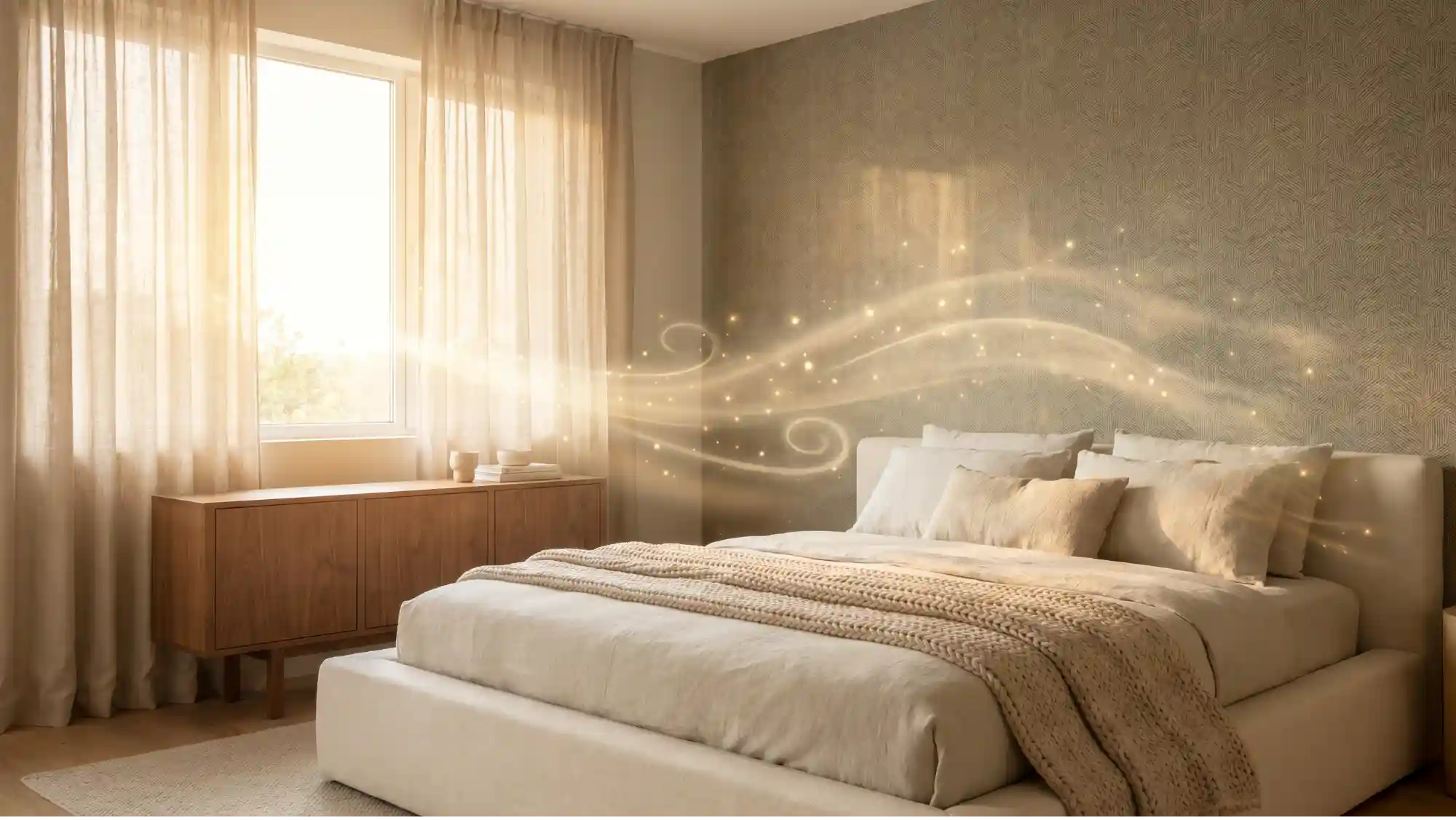
Article Summary: Discover why Feng Shui says stop replacing these 4 home items. Stability beats freshness — protect your qi field, health, and wealth with simple, stable choices.
Direct Answer: Should you stop replacing these 4 items?
Yes. In Feng Shui (Fēng Shuǐ 風水), your home's energy field (qi / chī 氣) needs time to stabilize — typically 3 to 6 months per major item. Frequent replacement of wallpaper, cabinets, bed, or curtains constantly resets this timer, keeping your home in a perpetual state of "unsettled energy." From a scientific angle, new furniture and adhesives release formaldehyde and VOCs for 3-15 years (EPA data). The Feng Shui rule: replace only when damaged or unsafe, not for freshness. Your home's stability directly affects your sleep quality, stress levels, and — according to traditional practice — your ability to retain wealth. Check your BaZi chart to see which elements need stability in your personal energy profile.


Why "Stability" Beats "Freshness" in Feng Shui
Walk into a hotel room and you'll sleep adequately. Walk into your own bedroom after 5 years, and you sleep deeply. In Feng Shui, that's qi field stabilization at work.
Feng Shui isn't about decorating. It's about energy field management. Your home is a living system that develops a "memory" through consistent, stable inputs. When you replace items frequently, you're essentially hitting the reset button on that memory every time.
Here's what most decorating blogs won't tell you: new doesn't equal better. In fact, from both Feng Shui and environmental health perspectives, "new" often means "disruptive."
"The best Feng Shui is boring. If your home looks exactly the same for 5 years, your qi field is probably healthy." — Master Xuanzhen
The science behind the tradition
You don't need to believe in Feng Shui to take this seriously. The EPA (Environmental Protection Agency) classifies formaldehyde as a hazardous air pollutant. It's released by:
- Wallpaper adhesive: peaks at 6-12 months, tapers over 3-5 years
- Cabinet particleboard: can off-gas for 10-15 years
- New mattresses: flame retardants + VOCs, peak at 2-6 months
- Curtain dyes: residual chemicals, especially in dark-colored fabrics
So when Feng Shui says "don't replace frequently," it's accidentally aligned with "don't keep introducing new off-gassing sources into your bedroom."
The 4 Items You Shouldn't Frequently Replace
1. Wallpaper: Don't replace frequently
The Feng Shui reason: Your walls are the "container" of your home's qi. Once wallpaper is up, the energy field gradually settles into that container. Replacing it ever 2-3 years constantly breaks that settled field. The pattern recognition system in your brain also relies on visual consistency — changing wallpaper forces your subconscious to re-process the room every time you enter.
The health reason: Wallpaper adhesive is a major source of indoor formaldehyde. A 2023 study from the Chinese Academy of Sciences found that renovated rooms had 3-8x higher formaldehyde levels than aged rooms, even 2 years after renovation.
What to do instead: Choose a high-quality, low-VOC wallpaper during renovation. After that, only repair damaged sections. If you're bored with the pattern, add removable wall art or rearrange furniture — don't rewrap the walls.
2. Cabinets: Don't add or replace often
The Feng Shui reason: Cabinets are where your home "stores qi." In Feng Shui theory, wealth qi prefers stillness — it accumulates in stable, unmoving structures. Frequent cabinet changes (adding more storage, replacing kitchen cabinets) disrupt this accumulation. I've seen several clients who replaced their kitchen cabinets and then had 6-12 months of financial instability afterward. Coincidence? Maybe. But why risk it.
The health reason: Particleboard cabinets are among the worst off-gassing offenders. The formaldehyde release rate is highest in the first 2 years, then gradually decreases — but never truly stops for 10-15 years.
What to do instead: Plan your storage during renovation. If you absolutely must add cabinets later, choose solid wood (lower off-gassing) and let them off-gas in a garage or balcony for 2 weeks before bringing indoors.
3. Bed: Don't replace or move
The Feng Shui reason: This is the big one. You spend 7-9 hours a day in bed — that's roughly one-third of your life. Your personal qi field merges with your bed's energy over time. After about 3 months, your sleep pattern, hormone cycles, and even dreams become synchronized with that specific bed.
Replace the bed, and you're starting that 3-month merge process all over again.
The health reason: Mattresses release flame retardants, adhesives, and VOCs. A 2022 study published in Environmental Science & Technology found that new mattresses can release up to 36 different VOCs in the first 6 months.
What to do instead: A good mattress lasts 8-10 years. Replace only when it's sagging or causing back pain. When you do replace it, choose a similar firmness level to your old one — this minimizes the "re-adjustment period."
4. Curtains: No need to replace frequently
The Feng Shui reason: Curtains control two things: light and privacy. Both are foundations of home energy stability. Feng Shui emphasizes "stable light" — the amount and quality of light entering your home should be consistent. Changing curtains frequently = changing the light pattern = disturbing the energy flow.
The health reason: Curtain fabrics, especially dark-colored or patterned ones, carry dye residues and finishing chemicals. Washing helps, but frequent replacement means you're constantly reintroducing these chemicals.
What to do instead: Wash curtains every 3-6 months. Replace only when faded beyond cleaning or mechanically damaged (torn, broken hooks). When you do replace them, choose a similar color and opacity level.
When Is It OK to Replace? (Decision Table)
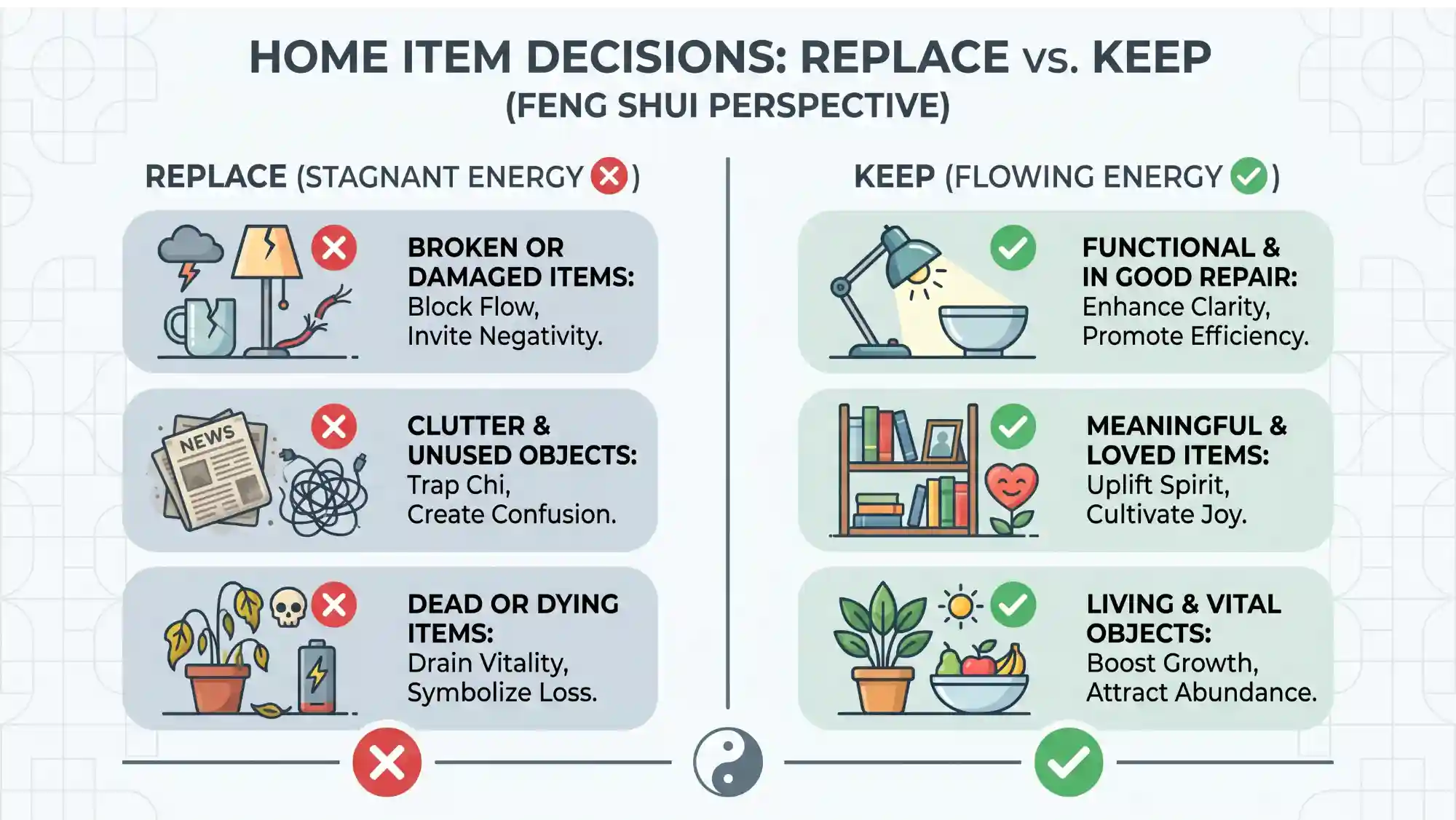
Not "never replace" — that would be unrealistic. Here's the practical framework:
| Situation | OK to replace? | Condition |
|---|---|---|
| Item is damaged, affecting function | ✅ Yes | Choose similar style/specs |
| Mold or hygiene concern | ✅ Yes | Ventilate room 3 days before use |
| Just "wanting a fresh look" | ❌ No | Refresh with cleaning + rearranging |
| Following trends | ❌ No | Stability beats trends in Feng Shui |
| Moving to a new home | ✅ Must | Allow 7 days for energy to settle |
| Responding to a feng shui audit | ✅ Yes | Only if master is experienced |
How to Stabilize Your Home's Qi Field
Beyond "not replacing these 4 items," here's what actually stabilizes a home's energy:
1. Clean regularly, but don't "redecorate" while cleaning
Dusting, vacuuming, mopping — all good. But if you're moving furniture around every time you clean, you're disrupting energy flow. Clean the same way each time.
2. Keep your sleeping position fixed
Your bed's headboard direction matters in Feng Shui, but consistency matters more. Don't flip your pillow to "the other side" or rotate your mattress every month — pick a schedule and stick to it.
3. Reduce impulse home purchases
That cute vase you saw on Instagram? Leave it there. Every new item introduces new energy into your home. One or two is fine. Ten new items in a month = energy chaos.
4. Know your personal element needs
This is where BaZi (八字) comes in. Your birth chart reveals which elements need stability vs. which need activation. Someone with excess Fire element might actually benefit from some "movement" in the home (to dissipate excess Fire). Someone with weak Earth element needs maximum stability.
Check your free BaZi chart to understand your personal energy profile — it changes how you approach home decorating.
The Bottom Line
Feng Shui prioritizes stable qi field over "fresh decor." These four items — wallpaper, cabinets, bed, and curtains — are worth choosing carefully once and then leaving alone.
Your home isn't a hotel room that needs refreshing every season. It's an energy system that rewards consistency.
Practical tip: Before your next home purchase, ask yourself: "Is this actually broken, or am I just bored?" If it's boredom, go for a walk instead. Your home's energy field will thank you.
Want to understand your personal energy needs? Check your free BaZi chart — it takes 30 seconds and reveals which elements need stability vs. activation in your home.
Frequently Asked Questions
How often should I replace wallpaper in Feng Shui?
Feng Shui suggests keeping wallpaper for at least 5-8 years. Frequent replacement disturbs the qi field that has stabilized in your home. From a health perspective, new wallpaper and adhesive emit formaldehyde and VOCs (volatile organic compounds) for 3-15 years according to EPA studies. If your wallpaper isn't damaged or moldy, repair local areas instead of rewrapping the entire room.
Can I move my bed to a different position?
In Feng Shui, the bed is where you spend one-third of your life rebuilding your energy. Once your qi has merged with a specific bed position, moving it can cause sleep instability, vivid dreams, and low energy. If you must move it (relocating, etc.), sleep in the new position for 7 consecutive nights to re-establish your energy connection. Also, avoid moving your bed during your unfavorable lunar month.
Do I need to replace curtains frequently for a fresh look?
No. Curtains control light and privacy — two pillars of home energy stability. Feng Shui emphasizes 'stable light' — frequent curtain changes alter room lighting and disturb the energy flow. New curtains also carry dye odors and chemical residues. Clean your curtains regularly instead of replacing them. If they're faded or damaged, choose a similar color to minimize energy disruption.
I'm renting. What if the previous tenant replaced everything?
Renters have less control, but you can still stabilize energy. Add a mattress topper to the bed (creates a buffer between your energy and the previous tenant's). Don't move the cabinets. Wash all curtains thoroughly before using. The principle is 'minimize change' — let your energy settle for at least 3 months before making any adjustments.
What if I already replaced all 4 items? Is my luck ruined?
No. Energy fields need time to restabilize — typically 3-6 months. During this period, spend more time at home to help your qi merge with the new items. Place a stability symbol (like a heavy stone or ceramic piece) in the center of your home. Most people notice their energy settling after one full lunar cycle. Patience matters more than perfection.