BaZi Astrology
How to Read a BaZi Chart (Step by Step)
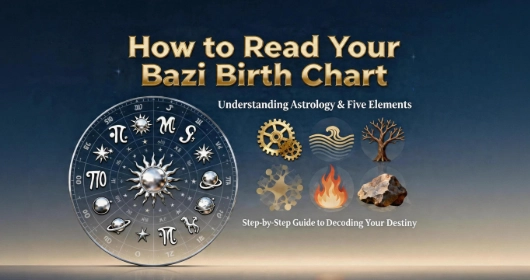
Yes, you can learn to read your own BaZi chart. The process follows a clear sequence: find your Day Master (the Heavenly Stem of your birth day), determine whether it's strong or weak based on birth season and supporting elements, then identify the Ten Gods relationships to understand your career direction, relationship style, and wealth patterns. The tricky part isn't the concepts — it's having a real chart to practice on. Generate your free BaZi chart in seconds, then use this guide to start reading it. For a complete structured learning path, our free 6-chapter course covers everything from Day Master basics to luck cycle interpretation.
What Is a BaZi Chart?
A BaZi chart (八字, literally "Eight Characters") is a personalized astrological blueprint based on the exact time of your birth. It maps the cosmic energy present at the moment you entered the world, revealing patterns in your personality, relationships, career, health, and life destiny.
The chart consists of four pillars — Year, Month, Day, and Hour — each represented by two Chinese characters (one Heavenly Stem + one Earthly Branch), giving us eight characters in total.


"The BaZi chart is not about fatalism. It reveals tendencies and potentials — like a weather forecast for your life. You still choose how to respond." — Traditional BaZi teaching
The Four Pillars Explained
1. Year Pillar (年柱)
Represents your ancestral background, social environment, and early life. It shows the broader context you were born into — your family's social standing, community influence, and the general energy of your generation.
2. Month Pillar (月柱)
Reveals your career potential, parental influence, and the primary energy of your birth season. This is considered one of the most important pillars because it determines whether your Day Master is "strong" or "weak" (得令 or 失令).
3. Day Pillar (日柱)
This is you. The Day Master (日主) — the Heavenly Stem of your Day Pillar — represents your core self, your fundamental nature, and how you interact with the world. The Earthly Branch of the Day Pillar relates to your spouse and intimate relationships.
4. Hour Pillar (时柱)
Reflects your children, inner desires,晚年 (later years), and subconscious drives. It shows the hidden aspirations and the legacy you leave behind.
How to Determine Your Day Master Strength
The most critical step in reading your BaZi chart is determining whether your Day Master is strong or weak. This determines your "useful god" (用神) — the element you need most.
Step 1: Identify your Day Master's element
Look at the Heavenly Stem of your Day Pillar. Each Heavenly Stem corresponds to one of the Five Elements:
| Heavenly Stem | Element | Yin/Yang |
|---|---|---|
| 甲 (Jiǎ) | Wood | Yang |
| 乙 (Yǐ) | Wood | Yin |
| 丙 (Bǐng) | Fire | Yang |
| 丁 (Dīng) | Fire | Yin |
| 戊 (Wù) | Earth | Yang |
| 己 (Jǐ) | Earth | Yin |
| 庚 (Gēng) | Metal | Yang |
| 辛 (Xīn) | Metal | Yin |
| 壬 (Rén) | Water | Yang |
| 癸 (Guǐ) | Water | Yin |
Step 2: Check the season (得令)
Is your Day Master born in a season that supports it?
- Wood: Strong in Spring (寅卯辰 months)
- Fire: Strong in Summer (巳午未 months)
- Earth: Strong in all transition months
- Metal: Strong in Autumn (申酉戌 months)
- Water: Strong in Winter (亥子丑 months)
Step 3: Count the supporting elements
Count how many other stems and branches share the same element as your Day Master or produce it (through the generating cycle).
Strong Day Master = born in the right season + many supporting elements Weak Day Master = born in the wrong season + few supporting elements
Understanding the Ten Gods (十神)
Once you know your Day Master, you can identify the Ten Gods — the relationship between your Day Master and every other element in your chart:
- Same element as you: 比肩 (Friend) or 劫财 (Rob Wealth)
- What you produce: 食神 (Eating God) or 伤官 (Hurting Officer)
- What you control: 正财 (Direct Wealth) or 偏财 (Indirect Wealth)
- What controls you: 正官 (Direct Officer) or 七杀 (Seven Killings)
- What produces you: 正印 (Direct Resource) or 偏印 (Indirect Resource)
Quick Personality Map
| If your chart is dominated by... | You tend to be... |
|---|---|
| 资源 (Resource / Yin水) | Nurturing, scholarly, introspective |
| 比劫 (Companion / Wood) | Independent, competitive, sociable |
| 食伤 (Output / Fire) | Creative, expressive, charismatic |
| 财星 (Wealth / Earth) | Practical, ambitious, business-minded |
| 官杀 (Power / Metal) | Disciplined, authoritative, leadership-oriented |
Common Patterns to Look For
🐉 Dragon in the Hour
If your Hour Branch is 辰 (Dragon), you may have a natural gift for leadership and transformation.
🔥 Three Fire pillars
A chart with strong Fire energy often indicates a charismatic, passionate personality — but watch for burnout.
💧 Water dominating Fire
If Water overcomes Fire in your chart, you may struggle with expressing emotions. Your useful god is likely Wood (to bridge Water and Fire).
⚔️ Clash Pattern (冲)
When two Earthly Branches in your chart clash (e.g., 子午 clash), it often indicates major life transitions or internal conflict in the area those branches represent.
Start reading your chart now. Get your free BaZi chart — it generates all four pillars, identifies your Day Master, and shows your Five Elements distribution. Then use this guide to interpret what you see. For a complete learning path from zero to chart reading, try our free 6-chapter BaZi course.
Frequently Asked Questions
What is a BaZi chart?
A BaZi chart is a Chinese astrological birth chart based on your birth year, month, day, and hour. It consists of four pillars, each with a Heavenly Stem and Earthly Branch, revealing your elemental composition and life patterns.
Can I read my BaZi chart by myself?
Yes! With basic knowledge of the Heavenly Stems, Earthly Branches, Five Elements, and Ten Gods, you can start interpreting your own chart. This guide walks you through the process step by step.
What are the Four Pillars in BaZi?
The Four Pillars are Year Pillar, Month Pillar, Day Pillar, and Hour Pillar. Each pillar has a Heavenly Stem (top) and Earthly Branch (bottom), making eight characters total — hence the name BaZi (Eight Characters).