Home Feng Shui
Feng Shui Home Office: 7 Rules
Why Your Desk Setup Matters More Than You Think
In 2026, over 35% of American employees work from home at least three days a week (Stanford WFH Research, 2025). Most of us obsess over chairs, monitors, and keyboards — but almost never think about something more basic: where the desk sits and which direction it faces.
Research from the Journal of Environmental Psychology (2024) found that workspace layout contributes 22% to sustained focus — more than room temperature, background noise, or lighting combined. That's a significant number for something most people set up once and never reconsider.
Chinese feng shui practitioners have studied spatial arrangement and human wellbeing for over 3,000 years. The practice isn't mystical — it's a structured system for optimizing how energy (qi) flows through a space, and its core principles often line up with modern environmental science.


The good news: every rule in this article comes with a specific action step. You can adjust your setup as you read.
The Commanding Position — Where Everything Starts
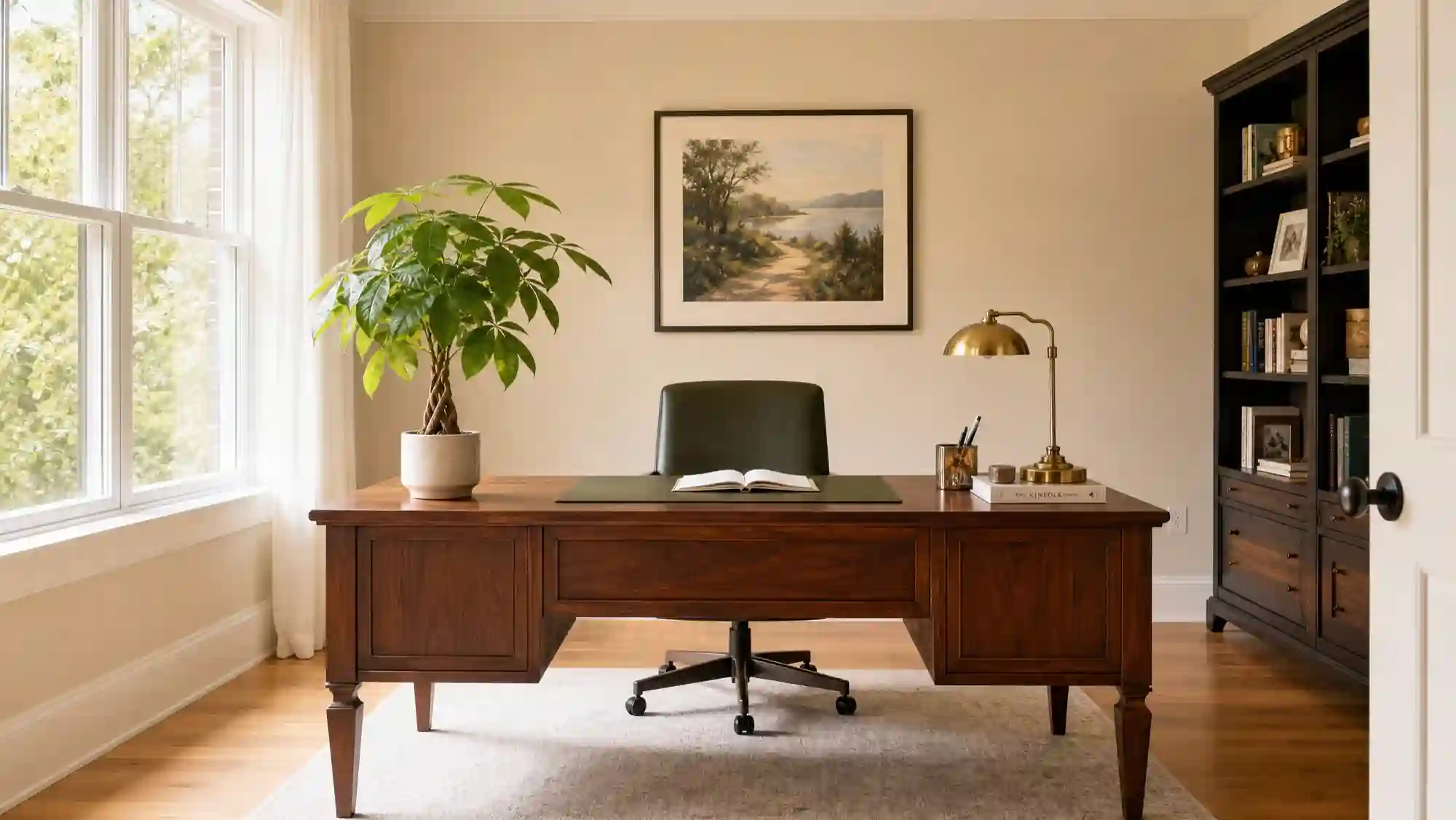
The commanding position (Pinyin: 明位, míng wèi) is the single most important principle in feng shui workspace design. Three conditions must be met simultaneously:
- Solid wall behind you (not a window, not an open hallway)
- You can see the door from your seated position
- You're not directly in line with the door (offset by at least 15-30 degrees)
Why this arrangement works. In traditional feng shui, a solid wall behind you represents "mountain support" (靠山, kào shān) — stability, backing, protection. Facing the door means you're aware of who enters your space. Being slightly off-center from the door line avoids "door rush energy" (門沖, mén chōng), where incoming qi hits you directly.
Modern neuroscience backs part of this up. A 2022 study on "back-side vigilance" (Rossi et al.) found that when people sit with their back exposed to open space, their brain's alertness system continuously consumes cognitive resources — even when they feel perfectly fine. You don't notice it happening, but your focus gradually erodes.
How to set it up right now:
- Sit in your current chair
- Turn your head: can you see the room's door? If not, try rotating your desk or repositioning your chair
- Check behind you: is your back against a solid wall? If you're facing a window or open hallway, try switching directions
- Check your front: is the door in a direct line with your face? If yes, shift your desk 15-30 degrees to either side
Checklist:
- I can see the door (within a 45-degree head turn)
- My back is against a solid wall
- The door is NOT directly in front of me in a straight line
Two common mistakes to avoid:
"I'll just face the door directly." This seems logical but actually violates the "not in a direct line" rule. When someone enters, the energy flow hits you head-on — feng shui practitioners call this door rush (門沖). You want to see the door, not be in its crosshairs.
"I'll put my desk against the window for the view." Natural light is great, but having your back to a window means zero wall support. If this is your only option, use heavy curtains behind you or invest in a chair with a high back (at least above head height) to create artificial support.
How BaZi and Feng Shui Work Together
Traditional feng shui has its own well-established rules for workspace layout — commanding positions, wealth corners, and Bagua zones. But there's a second layer that most feng shui articles don't cover: your personal BaZi chart (八字, bā zì) tells you what to place, while feng shui tells you where to place it.
Think of it this way:
- Feng shui = the map (which direction, which corner, which zone)
- BaZi favorable element = the cargo (what color, what material, what type of object)
Here's how the two systems connect:
Step 1: Run Your BaZi Chart
Run a free BaZi chart — it takes 30 seconds. The results will show your favorable element (喜用神, xǐ yòng shén) directly. This is the element your chart needs more of — it could be Wood, Fire, Earth, Metal, or Water.
Step 2: Match Your Favorable Element to Direction and Color
Once you know your favorable element, use this table:
| Favorable Element | Direction | Desk Color | Yin / Yang Nature |
|---|---|---|---|
| Wood (木) | East, Southeast | Greens | Yang (陽) — active, growing |
| Fire (火) | South | Red, purple, orange | Yang (陽) — bright, radiant |
| Earth (土) | Southwest, Center | Yellow, brown | Neutral |
| Metal (金) | West, Northwest | White, silver, gold | Yin (陰) — refined, contracting |
| Water (水) | North | Blue, black | Yin (陰) — deep, still |
The direction column comes from traditional feng shui's element-direction associations. The color column helps you choose desk mats, accessories, and decorative items. The yin/yang nature matters too — it tells you whether the objects you place should lean toward active/bright or calm/cool. This is especially relevant when choosing plants (see Rule 4).
Step 3: Apply It to Your Office Zone
Here's the combined logic in action:
- Your favorable element is Fire → sit facing South, use warm colors (red/orange desk mat), and choose sun-loving plants (yang-natured, like Money Tree) because Fire is a yang element
- Your favorable element is Water → sit facing North, use cool colors (blue/black), and choose shade-tolerant plants (yin-natured, like Snake Plant) because Water is a yin element
- Your favorable element is Wood → sit facing East or Southeast, use green tones, and choose sun-loving plants (yang-natured) because Wood is a yang element
Why this matters: Two people can follow the same feng shui layout advice and get different results, because their BaZi charts call for different elements. One person's wealth-enhancing setup might introduce the wrong energy for someone else. Your chart removes the guesswork.
7 Actionable Feng Shui Rules for Your Home Office
Rule 1: Find Your Commanding Position
Already covered above — this is your foundation. Every other rule builds on having your desk in the right spot.
Quick recap:
- Sit in your chair. Can you see the door?
- Is your back against a solid wall?
- Are you off-center from the door line?
If you answered yes to all three, move on. If not, go back to the commanding position section and adjust.
Rule 2: Declutter — Physical and Digital
Feng shui treats clutter as stagnant energy — it blocks the natural flow of qi through your workspace. Science agrees: a 2011 study at Princeton University's Neuroscience Lab found that visual clutter reduces focus by up to 30%.
Action steps:
- Remove everything from your desk except three categories: items for your current task, essential tools (pen, notebook), and one personal item
- File all papers into a drawer or folder system
- Bundle cables with a cable organizer
- Clean your computer desktop — delete unused shortcuts, organize remaining ones into folders
Checklist:
- Fewer than 10 visible items on my desk
- No stacked papers or books
- Cables are managed
- My computer desktop has fewer than 20 icons
Fair enough — full minimalism isn't for everyone. But if your desk surface is buried under stuff, start by clearing just one corner. The difference in how the space feels is immediate.
Rule 3: Match Your Desk Color to Your Favorable Element
Color is one of the easiest ways to introduce elemental energy into your workspace. You don't need to repaint the room — a desk mat in the right color does the job.
Action steps:
- Run your BaZi chart and note your favorable element
- Buy a desk mat (or mouse pad) in the matching color from the table above
- Coordinate one small desk accessory — pen holder, coaster, or organizer — in the same color family
Checklist:
- I know my BaZi favorable element
- My desk has at least one item in the matching color
- The color feels intentional, not random
Example: Your favorable element is Wood. A deep green desk mat (roughly $15-30) plus a small Money Plant on your left side — that's it. Two changes, five minutes.
Rule 4: Choose the Right Plant — Based on Your BaZi
Plants introduce living Wood energy (木氣) into your workspace. In feng shui, the left side of your desk is the "Dragon side" (龍邊, lóng biān) — it represents support and helpful people. But which plant you choose matters more than you might think.
Here's the key insight from BaZi: each of the Five Elements has a yin or yang nature, and your plant should match. If your favorable element is Fire (yang), you want a sun-loving plant that thrives in bright light. If your favorable element is Water (yin), a shade-tolerant plant suits you better. Matching the plant's nature to your chart's needs is how BaZi-informed feng shui works.
Step 1: Check your BaZi favorable element and its yin/yang nature (see the table in the section above)
Step 2: Pick a plant that matches:
| Your Favorable Element | Nature | Choose This Type | Recommended Plants |
|---|---|---|---|
| Wood (木) | Yang (陽) | Sun-loving, bright light | Money Tree, Jade Plant, Rubber Plant |
| Fire (火) | Yang (陽) | Sun-loving, warm spot | Money Tree, Aloe Vera (no sharp thorns — use a smooth-leafed variety), Poinsettia |
| Earth (土) | Neutral | Adaptable, low maintenance | Snake Plant, ZZ Plant, Peace Lily |
| Metal (金) | Yin (陰) | Shade-tolerant, cool-toned | Snake Plant, Peace Lily, Chinese Evergreen |
| Water (水) | Yin (陰) | Shade-tolerant, prefers humidity | Snake Plant, Boston Fern, Pothos |
Step 3: Place it correctly
- Position the plant on the left side of your desk (Dragon side)
- Keep the plant height below your eye level when seated
- Yang-natured plants (for Wood/Fire favoring charts) — place them where they can receive some natural light
- Yin-natured plants (for Metal/Water favoring charts) — they do fine in lower light, no need to force them into a sunny spot
Avoid these regardless of your BaZi:
- ❌ Cacti and thorny plants — sharp edges create sha qi (煞氣, inauspicious energy)
- ❌ Dried or artificial flowers — represent stagnant, lifeless energy
- ❌ Trailing vines placed above desk level — downward growth symbolizes energy draining away
- ❌ Any plant that's dying or wilting — a dead plant is worse than no plant at all
Checklist:
- I know my BaZi favorable element
- I chose a plant matching my element's yin/yang nature
- Plant is on the left side of my desk
- Plant is healthy, with no thorns or yellowing leaves
Rule 5: Set Up Your Light the Right Way
Feng shui distinguishes between "bright hall" (明堂, míng táng) and "dark room" (暗室, àn shì) — your workspace should be well-lit but not harshly so. This isn't about aesthetics. Light quality directly affects alertness, eye strain, and sleep cycle regulation.
Action steps:
- Position your desk so natural light comes from your side (left-front is ideal for right-handed people), not from behind your monitor or directly behind your back
- If the only window is behind you, use sheer curtains to diffuse the light and prevent monitor glare
- For evening work, use a warm-white desk lamp (2700-3000K color temperature) positioned on your left-front
- Avoid overhead fluorescent lighting — the hard, flat light disperses energy in feng shui and causes faster eye fatigue according to optometry research
Why color temperature matters: Blue-enriched light (above 5000K) suppresses melatonin production (Harvard Health Publishing, 2020). Using cool-white overhead lights late in the day is bad for both your circadian rhythm and your feng shui — evening should transition toward yin (restful) energy, not stay locked in yang (active) mode.
Checklist:
- Natural light comes from my side, not directly behind me
- I have a warm-white desk lamp for evening work
- My lamp is positioned on my left-front
Rule 6: Apply the Bagua Map to Your Office Zone
The Bagua (八卦) is a nine-grid energy map used in feng shui to identify which areas of a space correspond to which life domains. Overlaying it on your office zone lets you place reinforcing objects in specific spots.
Action steps:
- Stand at your office entrance (or the doorway of the room your desk is in) facing inward
- The bottom-center grid is your entrance position
- Identify the southeast corner (wealth) and north area (career) of your workspace
- Place one reinforcing item in each
Bagua quick reference for offices:
| Zone | Life Domain | What to Place |
|---|---|---|
| Southeast (SE) | Wealth (財) | Small crystal, a plant, or something green |
| South (S) | Recognition (名) | Lamp, certificate, or red accent |
| North (N) | Career (事業) | Something black or blue, or a small water feature |
| East (E) | Health (健康) | Wood element — plant or wooden item |
| Southwest (SW) | Relationships (人緣) | A pair of matching items or pink rose quartz |
Start with just two zones — southeast (wealth) and north (career). Don't try to fill all nine sections at once.
Checklist:
- I identified the southeast corner of my workspace
- I placed one item in the southeast corner (wealth zone)
- I placed one item in the north area (career zone)
Rule 7: Manage Your Tech — Yes, It Matters
Feng shui classifies electronic devices as strong yang energy. Too much concentrated yang in one spot creates imbalance. Some practical adjustments:
Action steps:
- Check your monitor: does it reflect your own face? This is called "mirror sitting" (照煞, zhào shà) and creates subtle psychological discomfort over long sessions. Tilt or reposition your screen slightly
- Move your Wi-Fi router at least 1 meter from your seat — don't sleep or sit next to it for extended periods
- Bundle charging cables when not in use
- After work, close your laptop and put it out of sight — this signals a shift from active (yang) to restful (yin) energy in your space
Checklist:
- My screen doesn't reflect my face
- Router is at least 1 meter from my seat
- Cables are organized
- I close and put away my laptop after work
Small Apartment? Here's How to Adapt
Not everyone has a dedicated home office. These are the three most common constraints — and real workarounds for each.
"My desk is in my bedroom."
The core issue: feng shui distinguishes between yang (active) energy for work and yin (restful) energy for sleep. Combining them creates what practitioners call "conflicting qi" (氣沖).
Fix: use a rug or different flooring to visually define your work zone. After finishing work, physically step out of that zone. A folding screen or tall bookshelf between your desk and bed helps too. The absolute rule: never work in bed. Keep the bed strictly for rest.
"I only have one wall, and the door is behind me."
You can't always get the commanding position perfectly. Here's the hierarchy of compromises:
- Best: high-backed chair (back at or above your head height) creates artificial mountain support
- Second best: a tall bookshelf or wardrobe positioned behind your chair
- Last resort: a heavy curtain behind you — not as solid as a wall, but better than open space
Note: some people suggest placing a small mirror to reflect what's behind you. I'd approach this with caution — most experienced feng shui practitioners I've encountered advise against mirrors at work desks, as they can create visual distraction and "doubled energy" that disturbs focus. A landscape painting with depth in your line of sight is a safer alternative.
"I share the workspace with someone else."
Each person needs their own commanding position. If you sit facing each other (common in shared rooms), place a medium-sized plant between the two desks to act as an energy buffer. A folding screen or bookshelf divider works even better.
Frequently Asked Questions
Which direction should my desk face for wealth?
In traditional feng shui, the southeast corner is the wealth zone (財位, cái wèi). But what you place there should match your BaZi favorable element. If you favor Fire, use warm-colored objects in that corner — if you favor Water, use cool-toned items. The direction you face also connects to your element: favoring Fire suggests facing South, favoring Water suggests facing North. Run a free BaZi chart to find your personal match.
What if my desk faces a wall and I can't move it?
Three options without moving furniture: (1) hang a landscape painting with depth — mountains, open fields — directly in your line of sight; (2) use a tall-backed chair behind you if your back faces an open area; (3) add a broad-leaf plant on your left side. Avoid placing mirrors on your desk — most experienced feng shui practitioners advise against it for workspaces.
Can feng shui really improve work productivity?
Feng shui is a traditional Chinese spatial practice, not a scientifically proven system. That said, many of its core principles overlap with environmental psychology findings: natural light improves alertness, organized spaces boost focus, and plants reduce stress (University of Exeter, 2014). The commanding position principle aligns with neuroscience research on vigilance drain. Think of it as a structured framework for applying these principles — with some cultural philosophy layered on top.
Is it bad feng shui to work and sleep in the same room?
It's not ideal. Feng shui distinguishes between active energy (yang, 陽) for work and restful energy (yin, 陰) for sleep. Mixing them in one space creates conflicting qi (氣沖). Practical fix: define separate zones using a rug, curtain, or room divider. Never work in bed — keep the bed strictly for rest. After work hours, close your laptop and put it out of sight.
What desk plants should I avoid in feng shui?
Avoid three categories: (1) sharp-thorned plants like cacti — they create sha qi (煞氣, inauspicious energy); (2) dried or artificial flowers — they represent stagnant, lifeless energy; (3) trailing vines placed above desk level — the downward growth symbolizes energy draining away. For plant selection, check your BaZi favorable element first — if you favor Fire or Wood (yang nature), choose sun-loving plants like Money Tree. If you favor Metal or Water (yin nature), choose shade-tolerant plants like Snake Plant or Peace Lily.
Your desk setup should reflect your personal energy — not a generic rule. Run your free BaZi chart to discover your favorable element and get personalized feng shui recommendations for your workspace. The chart takes 30 seconds and requires no sign-up. Already know your element? Go back to the BaZi and Feng Shui section above and start adjusting.
Frequently Asked Questions
Which direction should my desk face for wealth?
In traditional feng shui, the southeast corner is the wealth zone (財位, cái wèi). But what you place there should match your BaZi favorable element. If you favor Fire, use warm-colored objects — if you favor Water, use cool-toned items. The direction you face also connects to your favorable element: favoring Fire suggests facing South, favoring Water suggests facing North. Run a free BaZi chart to find your personal match.
What if my desk faces a wall and I can't move it?
Three options without moving furniture: (1) hang a landscape painting with depth directly in your line of sight — mountains, open fields — to create a sense of spaciousness; (2) use a tall-backed chair behind you if your back faces an open area; (3) add a broad-leaf plant on your left side. Avoid placing mirrors on your desk — most experienced feng shui practitioners advise against it for workspaces.
Can feng shui really improve work productivity?
Feng shui is a traditional Chinese spatial practice, not a scientifically proven system. However, many of its core principles overlap with environmental psychology: natural light improves alertness, organized spaces boost focus, and plants reduce stress (University of Exeter, 2014). The commanding position principle aligns with neuroscience research on vigilance drain. Think of feng shui as a structured framework for applying these principles.
Is it bad feng shui to work and sleep in the same room?
It's not ideal because feng shui distinguishes between active energy (yang) for work and restful energy (yin) for sleep. Mixing them can create what practitioners call conflicting qi. Practical fix: define separate zones using a rug, curtain, or room divider. Never work in bed. After work hours, close your laptop and put it out of sight.
What desk plants should I avoid in feng shui?
Avoid three categories: (1) sharp-thorned plants like cacti — they create sha qi (煞氣, inauspicious energy); (2) dried or artificial flowers — they represent stagnant energy; (3) trailing vines placed above desk level — the downward growth symbolizes energy draining. For plant selection, check your BaZi favorable element first — if you favor Fire or Wood (yang nature), choose sun-loving plants like Money Tree. If you favor Metal or Water (yin nature), choose shade-tolerant plants like Snake Plant or Peace Lily.