BaZi Astrology
Seven Killings in BaZi: Why This 'Dangerous' Star Can Make You Rich
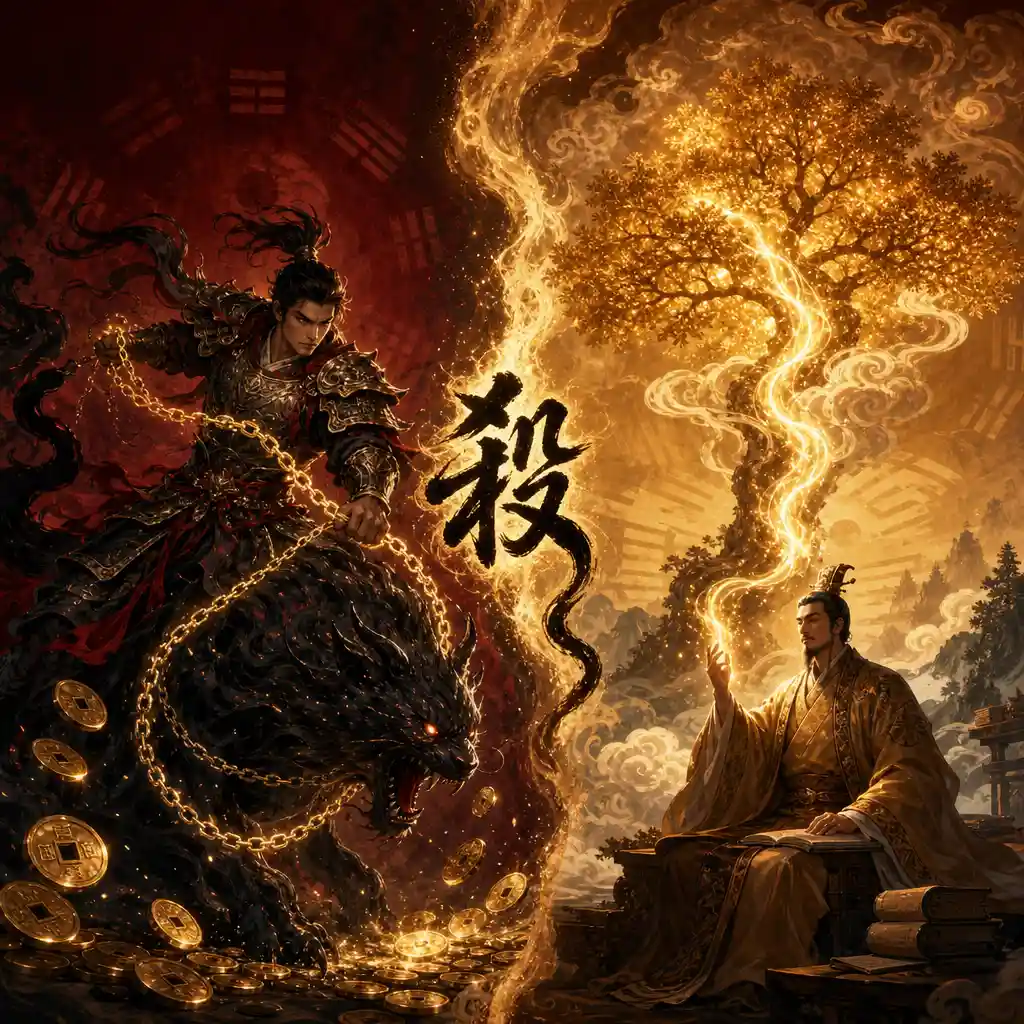
When people first see Seven Killings (七杀, Qī Shā) in their BaZi chart, the reaction is usually fear. The name alone sounds ominous — "killings" — and most introductory resources treat it as a problem to solve.
Here's what they get wrong: Seven Killings is not a curse. In classical BaZi, when properly managed, it's the single most powerful driver of wealth and status in your chart. The question isn't whether it's good or bad. The question is whether you're controlling it or transforming it — and that distinction determines your entire financial trajectory.
Let's break down why, using plain language instead of fortune-cookie mysticism.


Why Seven Killings Is Your Wealth Engine
Seven Killings is one of the Ten Gods (十神) in BaZi — specifically, it's the element that directly "attacks" your Day Master (your core self). For example, if you're a Yang Wood (甲木) person, Metal attacks Wood, so Metal is your Seven Killings.
On the surface, this sounds hostile. But in practice, Seven Killings represents:
- High-stakes pressure — the kind that forces extraordinary performance
- Competitive environments — rivals, obstacles, and challenges
- Risk and leverage — situations where the potential reward matches the danger
Think of it as the difference between a steady salary job (Direct Officer, 正官) and a high-risk startup bet. Direct Officer gives you stability. Seven Killings gives you the potential for outsized returns — if you can handle it.
The critical rule: Seven Killings needs to be "visible" and "usable." If it's buried deep in the hidden stems of an Earthly Branch and never surfaces, it can't do much. But when it's present in the Heavenly Stems or prominent in the branches, and your chart has a mechanism to manage it, you're sitting on what classical texts call a "wealth and rank double beauty" (财官双美) configuration — one of the most desirable patterns in BaZi.
Why Wealth Stars Are Subordinate to Seven Killings
This trips up a lot of people: if my chart has Wealth Stars (财星), shouldn't I focus on those instead?
The answer is instructive. In BaZi hierarchy:
- Wealth Stars (正财, 偏财) represent money and resources
- Seven Killings represents the power to command money and resources
It's the difference between having a pile of gold (Wealth) and having the authority to decide who gets access to the gold mine (Seven Killings). When both appear in the same chart, Seven Killings is the decision-maker. Wealth Stars follow its lead.
This is why many people with zero Wealth Stars in their chart have built extraordinary fortunes. Their Seven Killings, properly managed, generates wealth on a scale that regular Wealth Stars can't match. The money arrives through pressure, competition, and high-stakes deals rather than through a salary, inheritance, or steady business.
The flip side: if you can't manage the Seven Killings, even abundant Wealth Stars won't stay. Money comes in and flows right back out. Think of the athlete who earns millions but goes bankrupt — they had Wealth, but no mechanism to hold it.
The Two Paths: Controlling vs Transforming
There are only two ways to manage Seven Killings in BaZi, and they produce fundamentally different outcomes.
Path 1: Controlling Seven Killings (食伤制杀)
How it works: Your Output Stars — Food God (食神) and Hurting Officer (伤官) — actively dominate and redirect the Seven Killings pressure. Output is the element your Day Master produces, so this is fundamentally about using your own talent and intelligence to neutralize threats.
The logic chain: When Output controls Killings, and Wealth Stars are also present, you get:
Output tames Killings → Killings empowers Wealth → Wealth flows to you
This is called "Output controls Killings to generate Wealth" (食伤制杀生财), and it's one of the most powerful wealth-building configurations in BaZi.
Real-world translation: These are the entrepreneurs, founders, deal-makers, and competitive professionals. They thrive under pressure. Give them a rival and they perform better. Give them a crisis and they find the opportunity. They don't care about titles or prestige — they care about results and returns.
Wealth profile: High ceiling, high volatility. The money comes from doing, building, competing. They're willing to sacrifice comfort and security for upside. Think of the founder who sleeps in the office for three years and comes out owning 40% of a company.
Path 2: Transforming Seven Killings (印星化杀)
How it works: Your Resource Stars — Direct Resource (正印) and Indirect Resource (偏印) — convert the aggressive Seven Killings energy into authority and backing. Resource is what produces your Day Master, so this is about channeling hostile forces into protection and credibility.
The mechanism: Seven Killings attacks your Day Master → Resource steps in and absorbs the attack → the absorbed energy becomes prestige, titles, and institutional support.
Real-world translation: These are the executives, politicians, senior consultants, and people who rise through institutional hierarchies. They don't fight the system — they use the system. Pressure and opposition make them more credible, not less. They accumulate titles, positions, and platforms that others respect.
Wealth profile: Stable but capped. The money comes from position, not performance. A VP at a major corporation, a government official, a tenured professor — all comfortable, all respected, but the wealth ceiling is defined by the institution, not by their own ambition.
Which Path Generates More Wealth?
Classical BaZi is unambiguous on this point: controlling Seven Killings (制杀) generates more personal wealth than transforming it (化杀).
Here's why, in practical terms:
1. The controller focuses on money. The transformer focuses on status.
Output-controlling charts are wired for profit. They look at every situation and ask: "What's the upside?" Resource-transforming charts ask: "What does this do for my reputation and standing?" Over a lifetime, the person obsessed with upside tends to accumulate more wealth than the person obsessed with prestige.
2. Wealth damages the transformer's mechanism.
There's a structural tension in the transforming path: too much Wealth can actually corrupt the Resource Star (财多坏印). In BaZi, Wealth attacks Resource. So the more money a transforming-type person accumulates, the more their protective mechanism weakens. This creates a self-limiting dynamic — they can't get too rich without breaking the very system that made them successful.
Controllers don't have this problem. In their case, Wealth is the natural output of the controlling mechanism. More wealth = stronger system.
3. The transformer needs to spend wealth to maintain authority.
Seven Killings, even when transformed, still consumes energy. A CEO needs a certain lifestyle, certain connections, certain appearances. These cost money. The controller, by contrast, can be frugal and still effective — their power comes from competence, not perception.
4. The controller's ceiling is unlimited.
An entrepreneur who can tame pressure and convert it into deals has no structural upper bound on earnings. A corporate executive, no matter how high they climb, is still bounded by their organization's pay scale. Over decades, the compounding effect of uncapped earnings vs. capped salary creates a massive gap.
The Quick-Reference Breakdown
| Dimension | Controlling (制杀) | Transforming (化杀) |
|---|---|---|
| Mechanism | Output Stars tame Killings | Resource Stars convert Killings |
| Core drive | Results, profit, competition | Prestige, authority, titles |
| Wealth style | Entrepreneurial, volatile | Institutional, stable |
| Risk tolerance | High — actively seeks risk | Moderate — manages risk |
| Wealth ceiling | Uncapped | Bounded by platform |
| Best environment | Startups, sales, markets | Corporations, government, academia |
| Vulnerability | Burnout, overextension | Corruption, losing the platform |
| Ideal when | Chart is strong, Output is prominent | Chart needs support, Resource is strong |
What This Means for Your Chart
Finding Seven Killings in your chart isn't a reason to worry — it's a reason to understand which mechanism you have and lean into it accordingly.
If your chart controls Seven Killings: Stop playing it safe. You're built for higher-stakes environments than the one you're in. The pressure you feel isn't a warning sign — it's fuel. The more ambitious the target, the better you perform.
If your chart transforms Seven Killings: Stop envying the entrepreneurs. Your path runs through institutions, credentials, and authority. Build your platform, accumulate your titles, and let the structure pay you. Don't dilute your Resource mechanism by chasing raw profit.
If your chart has Seven Killings with no controlling or transforming mechanism: This is the one scenario where the concern is real. Unmanaged Seven Killings can manifest as repeated crises, health issues, or self-sabotaging risk behavior. The remedy is usually found in your 10-year luck cycles (大运) — when a helpful Output or Resource period arrives, the Killings suddenly become manageable and productive.
Further Reading
- Is a Weak Day Master Bad? The Truth About Shen Ruo in Bazi — Day Master strength is the foundation for handling Seven Killings.
- How to Read a BaZi Chart (Step by Step) — Learn to identify which Ten Gods appear in your chart.
- BaZi Ten Gods: What Your Chart Says About Friendships — A deeper look at how the Ten Gods shape your relationships.
- BaZi Major Luck Cycles: Why Your Life Shifts Every 10 Years — Understanding when your managing mechanism activates.
Written by Xuanzhen for Dao Essentia. Use our free BaZi calculator to check whether your chart contains Seven Killings — and whether Output or Resource Stars are there to manage it.
Frequently Asked Questions
Is Seven Killings always bad in a BaZi chart?
No. Seven Killings (七杀) is called the 'star of wealth and rank' (财官双美) in classical BaZi when properly managed. It represents high-stakes pressure that, when harnessed through either Output Stars (食伤制杀) or Resource Stars (印星化杀), becomes a massive driver of success. The danger only appears when Seven Killings is present but has no mechanism to control or transform it.
What's the difference between controlling and transforming Seven Killings?
Controlling (制杀) uses Output Stars — your Food God (食神) and Hurting Officer (伤官) — to actively dominate and redirect the pressure into productive action. Think of it as taming a wild horse to pull your carriage. Transforming (化杀) uses Resource Stars — your Direct Resource (正印) and Indirect Resource (偏印) — to convert the aggressive energy into authority and backing. Think of it as redirecting a river to irrigate your fields instead of flooding them.
Which path makes more money — controlling or transforming Seven Killings?
Classical BaZi generally gives the edge to controlling Seven Killings (制杀) for pure wealth accumulation. The logic: when your Output Stars tame the Killings, the resulting energy directly feeds into generating wealth. If Wealth Stars are also present in the chart, the chain becomes Output controls Killings → Killings empower Wealth → Wealth comes to you. Transforming (化杀) tends to produce prestige, titles, and institutional power rather than personal fortune.
Can someone with no Wealth Stars in their chart still become wealthy through Seven Killings?
Yes, and this is one of the most misunderstood patterns in BaZi. Seven Killings, when properly controlled, can function as a supercharged Wealth Star on its own. Many people with zero Wealth Stars (财星) have built extraordinary fortunes precisely because their Seven Killings was the dominant — and properly managed — force in their chart. The wealth just arrives through pressure, competition, and high-stakes deals rather than steady income.
How do I know if my chart controls or transforms Seven Killings?
You need to look at two things: (1) whether your Day Master is strong enough to handle the Killings, and (2) which mechanism is present in your chart. If your chart has strong Output Stars (especially Food God), you're likely a 'controller.' If Resource Stars dominate, you're a 'transformer.' Use our [free BaZi calculator](/#free-bazi) to map your chart, then check which of the Ten Gods appears most prominently alongside the Killings.