chinese-culture
Asking the Compass: Direction Divination
Asking the Compass: Direction Divination
Two small crises share the same morning: a ring that is no longer where it should be, and a decision with no leaning — which way should this go? Both feel like searching in the dark. The classical folk answer to both was the same instrument: the compass, used not for surveying a house but for asking a question.
This is the quiet sibling of temple divination. Fewer visitors know it, but in old households the dial answered the same kind of questions the oracle sticks did — with a direction and its omen instead of a verse.


The Short Answer
Direction divination (問事羅盤) frames one concrete matter, commits a number to a trigram dial, and reads the answering direction — one of twelve, each named by its trigram, each carrying its own omen. It suits two kinds of moments: finding what is lost — the dial names the side to search and the omen grades the search's fortune — and leaning a decision that has no natural direction. The reading is a reference for this moment, for the person asking — it does not survey geography, and it does not promise. The classical boundary stands: the dial gives the bearing; the walking is yours.
The Dial: Twelve Directions, Each with Its Trigram
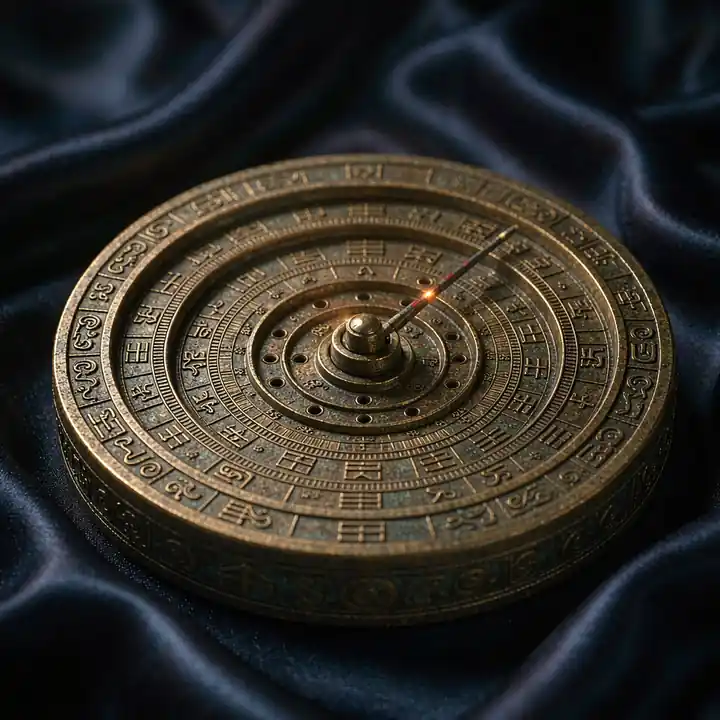
The compass face divides the circle into twelve bearings. Four are cardinal and carry pure trigrams: due north belongs to Water (坎), due east to Wood (震), due south to Fire (離), due west to Metal (兌). The eight in-between bearings carry blended readings, and the blends are where the dial shows its finesse — north by east, where Water and Mountain embrace; south by west, where Fire feeds Earth; west by north, where Metal grows strong.
Each direction is therefore more than a compass point: it is an image, a mood of the five elements at that bearing. When the reading lands, it lands somewhere specific — a bearing with a character already attached.
How to Ask
The practice lives or dies on how the question is framed.
Name the matter. Not "my lost item" but the item — the ring, the documents, the cat. Specificity turns a vague worry into a question the dial can answer.
Calm, then commit. The old instruction is to settle the mind before touching the dial — the same rule temple practice applies before shaking the stick cup. A hurried question gets a hurried answer. One matter per asking: ask about the trip, the meeting, the search — separately, each with its own bearing.
Commit a number. Between 1 and 99 — any number you hold in mind for the matter. The dial settles, and the bearing is set. The dial is no dice roll: the same number settles on the same bearing every time — what varies is the matter you bring to it.
Reading the Omen
The direction alone is half the answer; the other half is the omen that rides with it. Nine tones run from favorable to cautionary, and their counsel is startlingly practical:
A direction in its prime rewards bold steps — head toward it; it will likely go your way. A smooth direction asks only for an even pace — results will come. A direction meeting resistance calls for slow, careful movement: mind your words and you will avert trouble. One running against you is candid about the arithmetic — much effort, little yield — and advises pausing until the time is right. A dangerous bearing says choose another time or detour. An unclear sign says observe while moving; do not force it; the fog lifts on its own.
Finding What Is Lost
The dial's two classic jobs — reading a direction's fortune, and finding what is lost — are answered by the same pair of outputs: the bearing, and the omen riding with it.
For a lost object, ask precisely: name the item — the ring, the documents, the keys — and recall the last place you had it. Then commit the number. The dial answers with the bearing: search that side of the house, the office, or the route first.
The omen is the lost item's fortune for this search. A direction in its prime says the search is favored — turn things out thoroughly, it will likely go your way. A smooth bearing promises the item at an even pace: steady looking, steady finding. A resisted bearing asks for slow, careful searching — mind the false leads, and careful hands turn trouble around. A direction running against you is candid about the arithmetic: much searching, little yield — pause and try another day. An unclear sign says the time has not settled: do not force it; the fog lifts on its own.
One reading, two answers: which side to search, and how the search will go. The dial gives the bearing and its omen; the actual turning-out of drawers is yours.
The Old Boundaries
Three classical rules keep the instrument honest, and they are worth repeating exactly as the tradition states them.
It faces the person, not the land. A surveying compass aligns to magnetic north and measures degrees; this dial does not survey geography. It faces you, the asker: when a matter needs direction, it answers which way, from where you stand, favors you now.
Do not weary the oracle. The old warning — to ask again and again is to weary it, and a wearied oracle does not answer. If a direction was given and no new change has occurred, there is nothing new to ask. One calm question, one dial, one direction to act on.
The direction is one strand of three. Heaven's timing, the ground's favor, and human effort — the direction reading touches only one of the three. The classics put it plainly: true good fortune begins with a steady heart and careful steps. The bearing is a reference before an undertaking — not to be blindly believed, nor dismissed; the road, in the end, is walked out.
Try It
Our direction compass runs the practice online: hold the matter, commit a number between 1 and 99, and read the bearing with its trigram and omen — for lost items and undecided matters alike. Pair it with the Matter Oracle when the question needs a fortune answer instead of a direction, and with the almanac when the matter needs a date.
FAQ
What is direction divination? A classical folk practice: one concrete matter, a trigram dial, one of twelve answering directions with its own omen — a directional reference for the moment, not a location or a prediction.
How does a reading work? Hold the matter, calm the mind, commit a number (1–99). The dial lands on a bearing — due north Water, due east Wood, or a blended bearing where two trigrams meet — each with its omen line.
How do I ask about a lost object? Name the item and the last place you had it. The answer gives the side to search first, and the omen grades the search: favored and soon, steady, careful, or another day.
What do the omens say? Nine tones: in its prime, smooth, resisted, running against you, dangerous, unclear — each with practical counsel, from bold steps to waiting for the fog to lift.
Can it answer yes-or-no questions? No — the oracle sticks answer those. The compass answers questions with a direction in them.
Why not ask the same matter again? The classical warning: ask again and again and the oracle is wearied — and a wearied oracle does not answer. No new change, no new question.
Frequently Asked Questions
What is direction divination?
A classical folk practice: you hold a specific matter — a lost item, a step that needs a leaning — and commit a number to a trigram dial. The dial answers with one of twelve directions, each named by its trigram, and each carrying its own omen: in its prime, smooth, meeting resistance, running against you, or unclear. It is a directional reference for the moment, not a location or a prediction.
How does a reading work?
Hold the matter clearly, calm the mind, and commit a number between 1 and 99. The dial settles on one of twelve directions — due north carrying the Water trigram, due east Wood, due south Fire, due west Metal, and the in-between bearings carrying blended readings, such as where Water and Mountain embrace. Each direction arrives with its own omen line.
How do I ask about a lost object?
Ask precisely: name the item and the last place you remember having it. The reading returns a direction — search that side of the house or the route first — and the omen is the lost item's fortune for the search: favored and likely found soon, found at an even pace, hard-won with careful searching, or better left for another day.
What do the omens say?
Nine tones, from favorable to cautionary: a direction in its prime rewards bold steps; a smooth direction promises results at an even pace; a resisted direction asks for slow, careful movement; one running against you costs much and yields little — pause and wait for the right time; an unclear sign says observe while moving and do not force it.
Can it answer yes-or-no questions?
No — that is the oracle sticks' territory. The compass answers questions with a direction in them: where something is, which way favors a matter. It also reads nothing about the person asking; one question, one direction.
Why should a matter not be asked repeatedly?
The classical warning is old: to ask again and again is to weary the oracle, and a wearied oracle does not answer. If the direction was given and no new change has occurred, there is nothing new to ask. One calm question, one dial, one direction to act on.