chinese-culture
Zhou Gong Dream Dictionary Explained
Zhou Gong Dream Dictionary Explained
Someone dreams of a snake coiled at the foot of the bed and searches its meaning before breakfast. Someone else dreams their teeth are falling out and quietly worries all morning. These searches happen millions of times a month, worldwide. What surprises most people is the answer the Chinese tradition gives: it is often the opposite of what they feared.
That tradition has a name attached to it — Zhou Gong, the Duke of Zhou. His dream dictionary has been consulted in Chinese households for centuries, usually from a section tucked inside the almanac. This guide explains how the reading works, what the most-asked symbols mean, and where it is wise to draw the line.


The Short Answer
The Zhou Gong dream dictionary (周公解夢) organizes dreams by image — animals, weather, the body, buildings, actions — and attaches a classical reading to each. Those readings rest on three things: how a word sounds, what a symbol means culturally, and the Five Elements behind the scene. A snake, a funeral, a flood, a wedding: each enters the book as a shared code, refined over a thousand years of use.
It is a reading of the image, not a fortune. The old lines say what the image has traditionally pointed toward; what it means for your Tuesday is where your own judgment comes in.
Who Was the Duke of Zhou?
Zhou Gong lived around three thousand years ago, as regent of the young Zhou dynasty. Later generations remembered him as a sage with a gift for divination, and Confucius — who edited the classics Zhou Gong helped shape — once lamented that he had stopped dreaming of the Duke.
That sentence did more for the dream dictionary than any marketing campaign. "Dreaming of Zhou Gong" became the polite phrase for having a meaningful dream. When a practical, usable dream book appeared centuries later, his name was the natural one to put on the cover. Families kept it beside the almanac and checked it the morning after a strange night.
How a Zhou Gong Reading Actually Works
Homophones: the pun layer
Chinese has many words that sound alike, and the dream book leans on that. Fish (魚) sounds exactly like surplus (餘), so fish dreams point to abundance. A coffin (棺材) sounds like "office and wealth" (官財) — which is why one of the grimmest images in a Western dream is a money sign in the Chinese one. An umbrella (傘) sounds like "to scatter" (散), so sharing one with someone carries a parting note.
Cultural symbols: the shared layer
Dragons mean honor and renewal; red means celebration; white traditionally attends endings. A dragon ascending is a rise in standing. A bird entering the house is news on its way. These meanings are not personal discoveries — they are a cultural code most Chinese households absorbed long before they ever opened the book.
Five Elements: the balance layer
Behind the images sits the Five Elements framework. Water dreams relate to wealth and emotion — calm clear water reads one way, murky flooding water reads another. Fire ties to recognition and passion; trees and wood to growth and family; mountains to stability and support. When you know the element behind a scene, the classical line makes more sense.
Ten Dreams Everyone Asks About
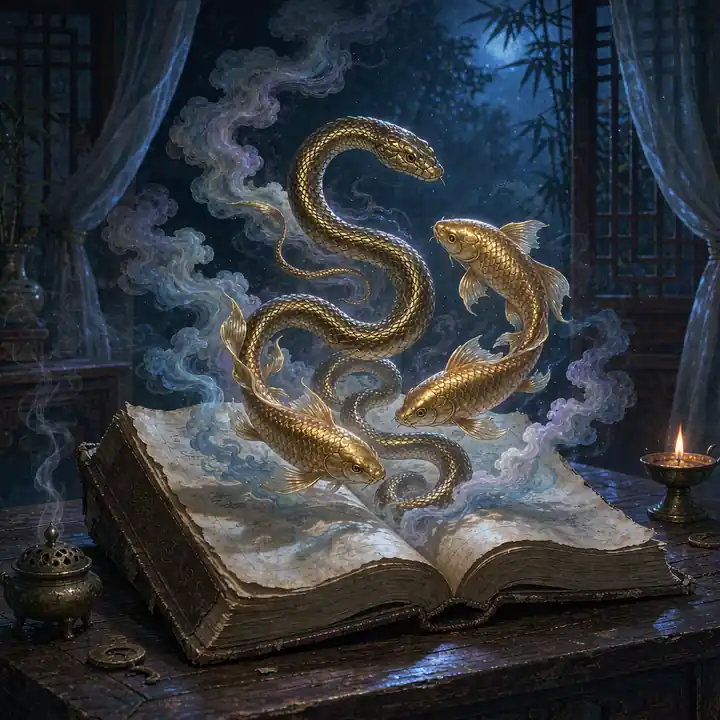
Snake (蛇). The most asked-about animal in the book. A bite is a money warning; a coiling snake is dormant potential. In taimeng — dreams said to announce a pregnancy — the snake is a classic sign.
Dragon (龍). Favorable across the board. Rising status, strong support, a gathering of fortune — especially when the dragon appears in water.
Fish (魚). Abundance, through the fish-surplus pun. Swimming freely is incoming prosperity; catching one, obtaining it. A dead fish reads as a missed opening.
Teeth falling out. Upper teeth touch elders, lower teeth the younger generation. The detail matters more than the alarm it causes at 3 a.m.
Death. Read as renewal — the turn where things improve. See the next section.
Flying. Smooth flight is advancement; struggling to stay airborne suggests the current pace is hard to hold. Falling after flying warns against overreach.
Water. Clear and calm: fortune gathering. Flooded or murky: emotional churn. Drinking water relates to health in the old lines.
Fire. Tied to recognition and passion. A house burning is, strangely, an auspicious image in this tradition — the old reading treats it as renewal of fortune.
A wedding — your own. Here the book flips expectations again: dreaming of your own wedding traditionally reads as separation or distance. The old lines enjoy these reversals.
Taimeng (胎夢). Dreams said to announce a child — dragons, snakes, fish, ripe fruit. Many families still tell these stories years later as part of a child's origin story.
Different classical sources do disagree on details — and this is where a careful reading earns its keep. The dream books were written in different eras and by different schools, and the same image is often read differently in each. Where the sources agree, a tendency shows clearly, and you can read it with confidence. Where they genuinely conflict, an honest reading declares nothing: it lays the variants side by side and lets you weigh them. Our dream reading tool works exactly this way — it gathers several classical dream books, shows the differing readings together, and refuses to stamp a fortune label on an image the books themselves dispute.
Death Dreams Are Usually Good News
This is the point worth underlining, because it is the one that flips a morning around. In the Zhou Gong tradition, dreaming of death is not read as loss. It marks a threshold: the old phase closing so the next one can start. The classical phrase is 否極泰來 — when negativity reaches its peak, fortune turns.
Add the coffin pun ("office and wealth") and the logic of the book becomes visible. It reads through change. Someone anxious after a death dream is usually misreading the code with Western eyes — which is exactly why the comparison below is useful.
Chinese vs Western Dream Analysis
| Chinese (Zhou Gong) | Western (Freud / Jung) | |
|---|---|---|
| Where meaning lives | Shared cultural code — puns, symbols, elements | The personal unconscious |
| A death dream | Renewal, a turning point | Anxiety about change or mortality |
| A snake | Wealth, wisdom, or a rival — by scene | The shadow, or change |
| Water | Wealth and emotion | The unconscious mind |
| Who the reading serves | Anyone — the code is cultural | Deeply personal to the dreamer |
Neither approach is the "correct" one. The Chinese tradition answers a different question: not what is hidden in me but what has this image meant, reliably, across centuries of households. For a dreamer who wants a place to start rather than a session of self-analysis, that shared code is the faster road.
Keep a Dream Journal
The dictionary works better with memory behind it. Classical practice says dreams before dawn carry the most weight, and that the images which return — the snake that shows up every few weeks, the water that keeps rising — deserve more attention than any single striking night.
Write the dream down before you move; details scatter within minutes. Note the strongest image rather than the whole plot. After a few weeks, patterns surface on their own.
Our free dream reading tool does the dictionary lookup for you: enter last night's dream, and it matches the classical entries, lays the different books' readings side by side, and weaves a psychological reading over the classical base — closing with one small, concrete suggestion. Every reading is saved to a journal automatically, and the journal shows which images return over time. And when one image keeps returning, the tool follows the tradition's gentlest rule: a recurring dream is not an omen — it is usually a matter you have not finished handling. When the matter lands, the dream changes on its own. If the dream touches decisions about names, beginnings, or dates — the almanac is the natural companion for the practical side, and the naming tool carries the same tradition into a child's first symbol.
FAQ
Who was Zhou Gong and why is the dream dictionary named after him? A Zhou-dynasty statesman remembered as a sage of divination. Confucius said he no longer dreamed of Zhou Gong — and "visiting Zhou Gong" became the phrase for a meaningful dream. The classical book took his name for exactly that reason.
What does dreaming of a snake mean in Chinese tradition? By scene: a bite is a money warning, a coiling snake is dormant potential, and in taimeng a snake is a classic sign of a coming child.
Why is dreaming of death considered good luck? The tradition reads death as a threshold — when negativity peaks, fortune turns. The coffin pun ("office and wealth") seals the image as favorable, not fearful.
What do teeth falling out mean? Upper teeth relate to elders, lower teeth to the younger generation, all teeth at once to a major change, and new growth to renewal.
How is this different from Freud or Jung? Western analysis reads inward, from your personal unconscious. Zhou Gong reads outward, from a shared cultural code. Same dream, different questions.
How do I start using the dictionary? Record the dream immediately, look up the strongest image, and track what returns. The free tool handles the lookup and keeps the journal for you.
Frequently Asked Questions
Who was Zhou Gong and why is the dream dictionary named after him?
Zhou Gong — the Duke of Zhou — was a statesman of the Western Zhou dynasty, remembered as a sage of divination. Confucius famously said he grieved that he no longer dreamed of the Duke of Zhou. Over time, 'visiting Zhou Gong in a dream' became a way of saying a dream carried meaning, and the classical dream book took his name.
What does dreaming of a snake mean in Chinese tradition?
It depends on the scene. A snake biting you is traditionally read as a warning about money matters. A coiling snake can point to dormant potential. In taimeng — the pregnancy-announcing dreams — a snake is one of the classic signs that a child is on the way.
Why is dreaming of death considered good luck in Chinese tradition?
Because the classical reading treats death as a turning point, not an ending — when negativity peaks, positivity returns. Even a coffin carries an auspicious pun: its name sounds like 'office and wealth'. So a death dream is read as renewal, and in practice it rarely means what a dreamer fears.
What do teeth falling out mean in a Chinese dream reading?
The tradition is oddly specific: upper teeth relate to elders and older family members, lower teeth to the younger generation. All teeth at once suggests a major life change. New teeth growing back is read as renewal and improved circumstances.
How is Chinese dream interpretation different from Freud or Jung?
Western analysis looks inward — the meaning comes from your personal unconscious. The Zhou Gong tradition looks outward — symbols carry shared cultural meanings: homophones, seasonal associations, and Five Element correspondences. One dream book can serve everyone because the code is cultural, not personal.
How do I start using the Zhou Gong dream dictionary?
Write your dream down before anything else — details fade within minutes. Note the strongest image, not the whole plot. Look up that image, read the traditional line, and check it against what is happening in your life. Our free dream reading tool does the lookup for you and keeps a journal.